Author Archives: Vilok

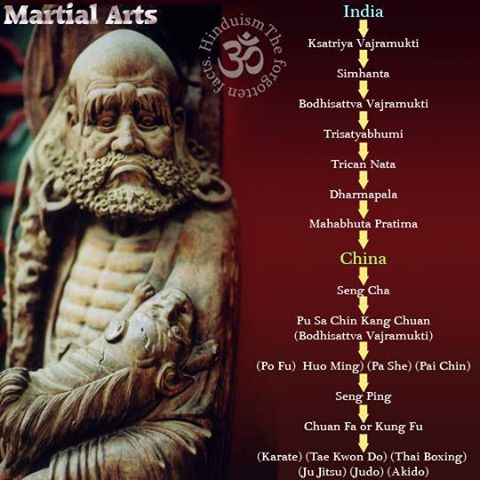
Martial Arts

11051792_1025663027466674_3291581252561071700_n

Martial Arts
According to author Terence Dukes:
“Fighting without weapons was a specialty of the Ksatreya (caste of Ancient India)and foot soldier alike. For the Ksatreya it was simply part and parcel of their all around training, but for the lowly peasant it was essential. We read in the Vedas of men unable to afford armor who bound their heads with turbans called Usnisa to protect themselves from sword and axe blows.
Search for Kalari Martial Arts and Silambam Martial Arts.
Fighting on foot for a Ksatreya was necessary in case he was unseated from his chariot or horse and found himself without weapons.
Although the high ethical code of the Ksatreya forbid anyone but another Ksatreya from attacking him, doubtless such morals were not always observed, and when faced with an unscrupulous opponent, the Ksatreya needed to be able to defend himself, and developed, therefore, a very effective form of hand-to-hand combat that combined techniques of wrestling, throws, and hand strikes.
Tactics and evasion were formulated that were later passed on to successive generations. This skill was called Vajramukhti, a name meaning “thunderbolt closed – or clasped – hands.”
The tile Vajramukti referred to the usage of the hands in a manner as powerful as the Vajra maces of traditional warfare. Vajramukti was practiced in peacetime by means of regular physical training sessions and these utilized sequences of attack and defense technically termed in Sanskrit nata.”
“Prior to and during the life of the Buddha various principles were embodied within the warrior caste known as the Ksatreya (Japanese: Setsuri). This title – stemming from Sanskrit root Ksetr meaning “power,” described an elite force of usually royal or noble-born warriors who were trained from infancy in a wide variety of military and martial arts, both armed and unarmed.
In China, the Ksatreya were considered to have descended from the deity Ping Wang (Japanese: Byo O), the “Lord of those who keep things calm.” Ksatreyas were like the Peace force – to keep kings and people in order. Military commanders were called Senani – a name reminiscent of the Japanese term Sensei which describes a similar status. The Japanese samurai also had similar traits to the Ksatreya. Their battle practices and techniques are often so close to that of the Ksatreya that we must assume the former came from India perhaps via China. The traditions of sacred Swords, of honorable self-sacrifice, and service to one’s Lord are all found first in India.
“In ancient Hinduism, nata was acknowledged as a spiritual study and conferred as a ruling deity, Nataraja, representing the awakening of wisdom through physical and mental concentration. However, after the Muslim invasion of India and its brutal destruction of Buddhist and Hindu culture and religion, the Ksatreya art of nata was dispersed and many of its teachers slain. This indigenous martial arts, under the name of Kalari or Kalaripayit exists only in South India today. Originating at least 1,300 years ago, India’s Kalaripayit is the oldest martial art taught today. It is also the most potentially violent, because students advance from unarmed combat to the use of swords, sharpened flexible metal lashes, and peculiar three-bladed daggers.
When Buddhism came to influence India (circa 500 B.c), the Deity Nataraja was converted to become one of the four protectors of Buddhism, and was renamed Nar (y)ayana Deva (Chinese: Na Lo Yen Tien). He is said to be a protector of the Eastern Hemisphere of the mandala.”

(source: The Boddhisattva Warriors: The Origin, Inner Philosophy, History and Symbolism of the Buddhist Martial Art Within India and China p.3 – 158-174 and 242).

Does the Universe Love YOU ?

DOES THE UNIVERSE LOVE ME?
It is a wrong question to ask. You should ask the other way round, “Do you love the universe?” because universe is not a person. It cannot love you. It has no center, or you can say “everywhere it has the center,” but it is a nonpersonal phenomenon. How can a nonpersonal existence love you? You can love.
But when you love, the universe responds — responds absolutely. If you take one step towards the universe, the universe takes a thousand and one steps towards you; but that’s a response.
You will have to understand what Lao Tzu says: that the nature of existence is feminine. A woman waits; she never initiates. The man has to go and initiate. The man has to come and woo and court and persuade. Existence is feminine — it waits You have to woo it; you have to court it; you have to take the initiative and then the universe showers on you — showers in infinite ways, fulfils in infinite ways. Just like a woman: when you have persuaded her she showers tremendously.
No man can be such a lover as a woman can be. A man remains always a part lover; his total being is never in love. A woman is totally in it; it is her whole life, her every breath. But she waits. She will never take the initiative, she will never chase you; and if a woman chases you — howsoever beautiful the woman — you will become scared of her. She won’t look feminine. She will be so aggressive that her whole beauty will turn into ugliness. A woman is passive. Remember this word “passive,” passivity.
Universe is the mother. It is always better to call the God “mother than “father.”
The father is not so relevant. Universe is the mother: feminine, waiting for you — waiting for you for ever and ever — but you will have to knock at the door. You will find it immediately opened if you knock, but if you don’t knock you can go on standing at the gate. The existence is not going to open it; it is not aggressive.
Even in love it is not aggressive. That’s why I say it will respond.
But don’t ask the wrong question. Don’t ask, “Does the universe love me?” Love the universe and you will find that your love is nothing. The universe gives you such infinite love, returns your love with such infinite response…. But it is a response — the universe never initiates; it waits. And it is beautiful that it waits; otherwise the whole beauty of love will be lost.
But this question arises; it has a relevance with your mind. This is how human mind functions: it always asks, “Does the other love me?” The woman, the wife, asks, “Does the husband love me?” The husband goes on asking, “Does the wife, the woman, love me?” The children go on thinking, “Does the mother, the father, love me?” and the parents go on thinking whether the children love them. You always ask about the other. You are asking a wrong question. You are moving in a wrong direction. You will come across a wall; you will not find a door. You will feel hurt because you will clash against the wall. The very beginning is wrong.
You should always ask, “Do I love the wife?” “Do I love the husband?” “Do I love the children?” “Do I love my father and my mother?” But always start from yourself — do you love.
And this is the mystery: if you love, suddenly you know everybody loves you. If you love the wife, she loves you; if you love the husband, he loves you; if you love the children, they love you. A person who loves from his heart is being responded to from everywhere. Love can never be fruitless. It blooms.
But you should start rightly, on the right track; otherwise everybody is asking, “Does the other love me?” and the other is also asking the same question. Then nobody loves, then love becomes just a fantasy, then love disappears from the earth — as it has happened. It has disappeared; it exists only in the poetries of poets — fantasies, imagination, dreams. Reality is absolutely devoid of love now, because you have started with a wrong question.
Drop that question like a disease. Drop it and escape from it, and always ask, “Do I love?’ and that will become the key. With that key you can open any heart, and with that key, by and by, you will become so artful that you can open the very existence with that key; then it becomes prayer. Just ask the question, “Does the universe pray to you?” Then it will look foolish; then it will look just absurd.
“Does the universe pray to you?” — you will not oven ask that; but prayer is nothing but the highest blossoming of love.
You pray to the universe and then you find from everywhere rivulets of love flowing towards you. You become fulfilled. The universe has much to give to you, but for that you have to be open. And the opening is possible only if you love: then you become open, otherwise you remain closed. And even the universe is helpless against your closedness.

~ OSHO – Yoga The Alpha and the Omega Volume 5
CHAPTER 6 : Does the universe love me?

Unconscious Inner Desire of the Soul !!!

There is a subtler level to the sexual experience than the mere physical routine.

It is a level that is religious in essence. To understand this experience you must pay careful attention. If you cannot grasp the meaning of this experience, you will live and die in sex alone.

Lightning shines in the darkness of the night, but the darkness is not part of the lightning. The only relation between the two is that lightning only stands out at night, only in the darkness. And the same is true of sex. There is a realization, an exhilaration, a light that shines in sex, but that phenomenon is not from sex itself. Although it is associated with it, it is just a by-product. The light that shines in orgasm transcends sex; it comes from beyond. If we can comprehend this experience of the beyond we can rise above sex. Otherwise, we will never be able to.

You can liberate yourself from sex if you can learn to attain to samadhi without sex. If a man who wants an article costing one thousand rupees is shown where one can be had for free, he would not be in his right senses if he were to go to the market to buy it so expensively. If a man can be shown how he can attain the same ecstasy he derives from sex by some other means and in much greater measure, his mind will automatically cease its rush towards sex; his mind will start racing in the other direction.

Man had his first realization of samadhi in the experience of sex.

But sex is a costly affair, a very costly affair indeed. And it does not last for more than a moment; after a momentary climax, we return again to our original position. For a second, we reach towards a different plane of existence; for a second, we climb towards a peak of immense satisfaction. The momentum is towards the pinnacle, but we have hardly taken a step when we fall back to first base. A wave aspires to reach the sky, but it has hardly risen noticeably when it already starts to fall. We are the same. It is for that ecstasy, for that joy, for that realization, that we accumulate energy from time to time and again start the ascent. We almost touch that subtler plane, that higher realm, but again we fall back to our original position, minus a considerable amount of power and energy.

So long as man’s mind remains immersed in this river of sex he will repeatedly rise and fall again. Life is a continuous push towards egolessness, towards timelessness — whether conscious or unconscious. The intense desire of the being is to know its real self, to know the truth, to know the original, eternal, timeless source — to unite with that which is beyond time, to attain pure egolessness. It is to satisfy this unconscious inner desire of the soul that the world rotates around the axis of sex.

~ Osho – Sex to Superconsciousness,Chapter 2

Enlightenment

You can not become ONE in love. you can only have an illusion of becoming one in love.And that is the great desire – how to be one, how to be one with the whole. how to fall in rapport with reality, how to disappear utterly. Because if you are , there is misery ; if you are, there is anguish ; if you are, there is anxiety.
The very ego creates the problem. when you melt and disappear, when you become one, there is nobody left behind. You are just a wave in this eternal ocean of existence. You don’t have a center of your own; the center of the whole has become your center. Then anxiety disappears, the anguish disappears, then the potential has become actual. This is what is called ” Enlightenment “, this is what is called ” NIRVANA ” or ” God realisation” .

~ OSHO – chapter #4 : Love cannot deliver the goods,
Sufis : The people of path , vol:1

Dhyana & Samadhi

Meditation has two parts: the beginning and the end.
The beginning is called dhyana and the end is called samadhi.
Dhyana is the seed, samadhi is the flowering. Dhyana means becoming aware of all workings of your mind, all the layers of your mind – your memories, your desires, your thoughts, dreams – becoming aware of all that goes on inside you.Dhyana is awareness,
and samadhi is when the awareness has become so deep, so profound,
so total that it is like a fire and it consumes the whole mind and all its functionings. It consumes thoughts, desires, ambitions, hopes, dreams. It consumes the whole stuff the mind is full of.
Samadhi is the state when awareness is there, but there is nothing to be aware inside you; the witness is there, but there is nothing to be witnessed.
Begin with dhyana, with meditation, and end in samadhi, in ecstasy, and you will know what God is. It is not a hypothesis, it is an experience. You have to LIVE it – that is the only way to know it.

~ OSHO – I AM THAT
CHAPTER 2. LIVING IN YOUR OWN LIGHT
Talks on the Isha Upanishad