The purpose of this category is to rewrite the TRUE & AUTHENTIC World & Indian History without any Pride or Prejudice towards any individual or community or country or religion. Also the purpose of this category is to explore the Sciences behind different Customs & Traditions, Rituals & Followings, Mythology & Scriptures.
Ancient Vedic science “Nimisharda” is a phrase used in Indian languages of Sanskrit origin while referring to something that happens/moves instantly, similar to the ‘blink of an eye’. Nimisharda means half of a Nimesa, (Ardha is half).
In Sanskrit ‘Nimisha’ means ‘blink of an eye’ and Nimisharda implies within the blink of an eye. This phrase is commonly used to refer to instantaneous events.
Below is the mathematical calculations of a research done by S S De and P V Vartak on the speed of light calculated using the Rigvedic hymns and commentaries on them.
The fourth verse of the Rigvedic hymn 1:50 (50th hymn in book 1 of rigveda) is as follows:
तरणिर्विश्वदर्शतो जयोतिष्क्र्दसि सूर्य | विश्वमा भासिरोचनम |
taraNir vishvadarshato jyotishkrdasi surya | vishvamaa bhaasirochanam ||
which means:
“Swift and all beautiful art thou, O Surya (Surya=Sun), maker of the light, Illumining all the radiant realm.”
Commenting on this verse in his Rigvedic commentary, Sayana who was a minister in the court of Bukka of the great Vijayanagar Empire of Karnataka in South India (in early 14th century) says:
” tatha ca smaryate yojananam. sahasre dve dve sate dve ca yojane ekena nimishardhena kramaman.” which means “It is remembered here that Sun (light) traverses 2,202 yojanas in half a nimisha”
NOTE: Nimisharda= half of a nimisha.
In the vedas Yojana is a unit of distance and Nimisha is a unit of time.
Unit of Time: Nimesa.
The Moksha dharma parva of Shanti Parva in Mahabharata describes Nimisha as follows: 15 Nimisha = 1 Kastha.
30 Kashta = 1 Kala,
30.3 Kala = 1 Muhurta,
30 Muhurtas = 1 Diva-Ratri (Day-Night),
We know Day-Night is 24 hours So we get 24 hours = 30 x 30.3 x 30 x 15 nimisha, in other words 409050 nimisha.
We know 1 hour = 60 x 60 = 3600 seconds.
So 24 hours = 24 x 3600 seconds = 409050 nimisha.
409050 nimesa = 86,400 seconds,
1 nimesa = 0.2112 seconds (This is a recursive decimal! Wink of an eye=.2112 seconds!).
1/2 nimesa = 0.1056 seconds.
Unit of Distance:
Yojana Yojana is defined in Chapter 6 of Book 1 of the ancient vedic text “Vishnu Purana” as follows:-
10 ParamAnus = 1 Parasúkshma,
10 Parasúkshmas = 1 Trasarenu,
10 Trasarenus = 1 Mahírajas (particle of dust),
10 Mahírajas= 1 Bálágra (hair’s point),
10 Bálágra = 1 Likhsha,
10 Likhsha= 1 Yuka,
10 Yukas = 1 Yavodara (heart of barley),
10 Yavodaras = 1 Yava (barley grain of middle size),
10 Yava = 1 Angula (1.89 cm or approx 3/4 inch),
6 fingers = 1 Pada (the breadth of it),
2 Padas = 1 Vitasti (span),
2 Vitasti = 1 Hasta (cubit),
4 Hastas = a Dhanu,
1 Danda, or paurusa (a man’s height),
or 2 Nárikás = 6 feet,
2000 Dhanus = 1 Gavyuti (distance to which a cow’s call or lowing can be heard) = 12000 feet 4 Gavyutis = 1 Yojana = 9.09 miles
Calculation: So now we can calculate what is the value of the speed of light in modern units based on the value given as 2202 Yojanas in 1/2 Nimesa = 2202 x 9.09 miles per 0.1056 seconds = 20016.18 miles per 0.1056 seconds = 189547 miles per second !!
As per the modern science speed of light is 186000 miles per second ! And so I without the slightest doubt attribute the slight difference between the two values to our error in accurately translating from Vedic units to SI/CGS units. Note that we have approximated 1 Angula as exactly 3/4 inch. While the approximation is true, the Angula is not exactly 3/4 inch.
The apologists of Islam and their secularist lick-spittles argue that if the Muslim conquerors had practised such systematic, extensive, and continued terror against Hindus and Hinduism as has been recorded by the Muslim historians of medieval India, Hindus could not have survived as an overwhelming majority at the end of the long spell of Muslim rule.
The logic here is purely deductive (formal). Suppose a person is subjected to a murderous assault, but he survives because he fights back. Deductively it can be concluded that the person never suffered a murderous assault because otherwise he could not have been alive! But this conclusion has little relevance to the facts of the case.
My sixth question, therefore, is: Did Hindus survive as a majority in their own homeland because the Islamic invaders did not employ sufficient force to kill or convert them, or because, though defeated again and again by the superior military skill of the invaders, Hindu princes did not give up resistance and came back again and again to reconquer their lost kingdoms, to fight yet another battle, yet another day, till the barbarians were brought to book?
Before I answer this question, I should like to warn against a very widely prevalent though a very perverse version of Indian history. In this popular version, Indian history has been reduced to a history of foreign invaders who were able to enter India from time to time – the so-called Aryans, the Iranians, the Greeks, the Parthians, the Scythians, the Kushanas, the Hunas, the Arabs, the Turks, the Pathans, the Mughals, the Persians, the Portuguese, the Dutch, the French, and the British. The one impression which this version of Indian history leaves, is that India has always been a no-man�s land which any armed bandit could come and occupy at any time, and that Hindus have always been a �meek mob� which has always bowed before every �superior� race.
Muslims in India and elsewhere have been led to believe by the mullahs and Muslim historians that the conquest of India by Islam started with the invasion of Sindh by Muhammad bin Qasim in 712 AD, was resumed by Mahmud Ghaznavi in 1000 AD, and completed by Muhammad Ghuri when he defeated the Chauhans of Ajmer and the Gahadvads of Kanauj in the last decade of the 12th century. Muslims of India in particular have been persuaded to look back with pride on those six centuries, if not more, when India was ruled by Muslim emperors. In this make-belief, the British rulers are treated as temporary intruders who cheated Islam of its Indian empire for a hundred years. So also the �Hindu Banias�, who succeeded the British in 1947 AD. Muslims are harangued every day, in every mosque and madrasah, not to rest till they reconquer the rest of India which, they are told, rightfully belongs to Islam.
The academic historians also agree that India was ruled by Muslim monarchs from the last decade of the 12th century to the end of the 18th. The standard textbooks of history, therefore, narrate medieval Indian history in terms of a number of Muslim imperial dynasties ruling from Delhi – the Mamluks (Slaves), the Khaljis, the Tughlaqs, the Sayyids, the Lodis, the Surs, the Mughals. The provincial Muslim dynasties with their seats at Srinagar, Lahore, Multan, Thatta, Ahmedabad, Mandu, Burhanpur, Daulatabad, Gulbarga, Bidar, Golconda, Bijapur, Madurai, Gaur, Jaunpur, and Lucknow fill the gaps during periods of imperial decline.
It is natural that in this version of medieval Indian history the recurring Hindu resistance to Islamic invaders, imperial as well as provincial, looks like a series of sporadic revolts occasioned by some minor grievances of purely local character, or led by some petty upstarts for purely personal gain. The repeated Rajput resurgence in Rajasthan, Bundelkhand and the Ganga-Yamuna Doab; the renewed assertion of independence by Hindu princes at Devagiri, Warrangal, Dvarasamudra and Madurai; the rise of the Vijayanagara Empire; the farflung fight offered by the Marathas; and the mighty movement of the Sikhs in the Punjab – all these then get readily fitted into the framework of a farflung and enduring Muslim empire. And the Hindu heroes who led this resistance for several centuries get reduced to ridiculous rebels who disturbed public peace at intervals but who were always put down.
But this version of medieval Indian history is, at its best, only an interpretation based on preconceived premises and propped up by a highly selective summarisation, or even invention, of facts. There is ample room for another interpretation based on more adequate premises, and borne out by a far better systematisation of known facts.
What are the facts? Do they bear out the interpretation that India was fully and finally conquered by Islam, and that the Muslim empire in India was a finished fabric before the British stole it for themselves by fraudulent means?
MUSLIM INVASIONS WERE NO WALK-OVER
The so-called conquest of Sindh first.
Having tried a naval invasion of India through Thana, Broach, and Debal from 634 to 637 AD, the Arabs tried the land route on the north-west during AD 650-711. But the Khyber Pass was blocked by the Hindu princes of Kabul and Zabul who inflicted many defeats on the Arabs, and forced them to sign treaties of non-aggression. The Bolan pass was blocked by the Jats of Kikan. AI Biladuri writes in his Futûh-ul-Buldãn: �At the end of 38 H. or the beginning of 39 H. (659 A.D.) in the Khilafat of Ali� Harras� went with the sanction of the Khalif to the same frontier� He and those who were with him, saving a few, were slain in the land of Kikan in the year 42 H. (662 A.D.). In the year 44 H. (664 A.D) and in the days of Khalif Muawiya, Muhallab made war on the same frontier� The enemy opposed him and killed him and his followers� Muawiya sent Abdullah� to the frontier of Hind. He fought in Kikan and captured booty� He stayed near the Khalif some time and then returned to Kikan, when the Turks (Hindus) called their forces together and slew him.�
Next, the Arabs tried the third land route, via Makran. Al Biladuri continues: �In the reign of the same Muawiya, Chief Ziyad appointed Sinan� He proceeded to the frontier and having subdued Makran and its cities by force, he stayed there� Ziyad then appointed Rashid� He proceeded to Makran but he was slain fighting against the Meds (Hindus)� Abbad, son of Ziyad then made war on the frontier of Hind by way of Seistan. He fought the inhabitants� but many Musulmans perished� Ziyad next appointed Al Manzar. Sinan had taken it but its inhabitants had been guilty of defection� He (Al Manzar) died there� When Hajjaj� was governor of Iraq, Said� was appointed to Makran and its frontiers. He was opposed and slain there. Hajjaj then appointed Mujja� to the frontier� Mujja died in Makran after being there a year� Then Hajjaj sent Ubaidullah� against Debal. Ubaidullah being killed, Hajjaj wrote to Budail� directing him to proceed to Debal� the enemy surrounded and killed him. Afterwards, Hajjaj during the Khilafat of Walid, appointed Mohammad, son of Qasim� to command on the Sindhian frontier.� That was in 712 AD.
Now compare this Arab record on the frontiers of India with their record elsewhere. Within eight years of the Prophet�s death, they had conquered Persia, Syria, and Egypt. By 650 AD, they had advanced upto the Oxus and the Hindu Kush. Between 640 and 709 AD they had reduced the whole of North Africa. They had conquered Spain in 711 AD. But it took them 70 long years to secure their first foothold on the soil of India. No historian worth his salt should have the cheek to say that the Hindus have always been an easy game for invaders.
Muhammad bin Qasim succeeded in occupying some cities of Sindh. His successors led some raids towards the Punjab, Rajasthan, and Saurashtra. But they were soon defeated, and driven back. The Arab historians admit that �a place of refuge to which the Muslims might flee was not to be found�. By the middle of the 8th century they controlled only the highly garrisoned cities of Multan and Mansurah. Their plight in Multan is described by AI Kazwin in Asr-ul-Bilãd in the following words: �The infidels have a large temple there, and a great idol� The houses of the servants and devotees are around the temple, and there are no idol worshippers in Multan besides those who dwell in those precincts� The ruler of Multan does not abolish this idol because he takes the large offerings which are brought to it� When the Indians make an attack upon the town, the Muslims bring out the idol, and when the infidels see it about to be broken or burnt, they retire.� (emphasis added). So much for Islamic monotheism of the Arabs and their military might. They, the world-conquerors, failed to accomplish anything in India except a short-lived raid.
It was some two hundred years later, in 963 AD, that Alptigin the Turk was successful in seizing Ghazni, the capital of Zabul. It was his successor Subuktigin who seized Kabul from the Hindu Shahiyas shortly before he died in 997 AD. His son, Mahmud Ghaznavi, led many expeditions into India between 1000 and 1027 AD. The details of his destructive frenzy are too well-known to be repeated. What concerns us here is the facile supposition made by historians in general that Mahmud was not so much interested in establishing an empire in India as in demolishing temples, plundering treasures, capturing slaves, and killing the kãfirs. This supposition does not square with his seizure of the Punjab west of the Ravi, and the whole of Sindh. The conclusion is unavoidable that though Mahmud went far into the heartland of Hindustan and won many victories, he had to beat a hasty retreat every time in the face of Hindu counterattacks. This point is proved by the peril in which he was placed by the Jats of the Punjab during his return from Somnath in 1026 AD.
The same Jats and the Gakkhars gave no end of trouble to the Muslim occupants of Sindh and the Punjab after Mahmud was dead. Another 150 years were to pass before another Islamic invader planned a conquest of India. This was Muhammad Ghuri. His first attempt towards Gujarat in 1178 AD met with disaster at the hands of the Chaulukyas, and he barely escaped with his life. And he was carried half-dead from the battlefield of Tarain in 1191 AD. It was only in 1192 AD that he won his first victory against Hindus by resorting to a mean stratagem which the chivalrous Rajputs failed to see through.
THE TURKISH EMPIRE WAS TEMPORARY
Muhammad Ghuri conquered the Punjab, Sindh, Delhi, and the Doab upto Kanauj. His general Qutbuddin Aibak extended the conquest to Ajmer and Ranthambhor in Rajasthan, Gwalior, Kalinjar, Mahoba and Khajuraho in Bundelkhand, and Katehar and Badaun beyond the Ganges. His raid into Gujarat was a failure in the final round though he succeeded in sacking and plundering Anahilwar Patan. Meanwhile, Bakhtyar Khalji had conquered Bihar and Bengal north and west of the Hooghly. He suffered a disastrous defeat when he tried to advance into Assam.
But by the time Muhammad Ghuri was assassinated by the Gakkhars in 1206 AD, and Aibak assumed power over the former�s domain in India, Kalinjar had been reconquered by the Chandellas, Ranthambhor had renounced vassalage to Delhi, Gwalior had been reoccupied by the Pratihars, the Doab was up in arms under the Gahadvad prince Harishchandra, and the Katehar Rajputs had reasserted their independence beyond the Ganges. The Yadavbhatti Rajputs around Alwar had cut off the imperial road to Ajmer. Aibak was not able to reconquer any of these areas before he died in 1210 AD.
Aibak�s successor, Iltutmish, succeeded in retaking Ranthambhor and Gwalior, and in widening his base around Ajmer. But he suffered several defeats at the hands of the Guhilots of Nagda, the Chauhans of Bundi, the Paramars of Malwa, and the Chandellas of Bundelkhand. Beyond the Ganges, the Katehar Rajputs had consolidated their hold which the Sultan could not shake. The Doab was still offering a very stiff resistance. His grip on Ajmer had also started slipping by the time he died in 1236 AD.
The Sultanate suffered a steep decline during the reigns of Razia, Bahrain, Masud, and Mahmud of the Shamsi dynasty founded by Iltutmish, though its dissolution was prevented by Balban who wielded effective power from 1246 AD onwards. The Muslim position in Bengal was seriously threatened by Hindu Orissa. Another Muslim invasion of Assam ended in yet another disaster in which the Muslim general lost his life and a whole Muslim army was annihilated, Hindu chieftains now started battering the Muslim garrison towns in Bihar. Near Delhi, the Chandellas advanced up to Mathura. The Rajputs from Alwar made raids as far as Hansi, and became a terror for Muslims even in the environs of Delhi. Balban�s successes against this rising tide of Hindu recovery were marginal. He suffered several setbacks. The Sultanate was once more reduced to rump around Delhi when Balban died in 1289 AD.
Dr. R.C. Majumdar has summed up the situation so far in the following words: �India south of the Vindhyas was under Hindu rule in the 13th century. Even in North India during the same century, there were powerful kingdoms not yet subjected to Muslim rule, or still fighting for their independence� Even in that part of India which acknowledged the Muslim rule, there was continual defiance and heroic resistance by large or small bands of Hindus in many quarters, so that successive Muslim rulers had to send well-equipped military expeditions, again and again, against the same region� As a matter of fact, the Muslim authority in Northern India, throughout the 13th century, was tantamount to a military occupation of a large number of important centres without any effective occupation, far less a systematic administration of the country at large.�
Jalaluddin Khalji failed to reconquer any land which had been lost by Muslims during the earlier reign. Alauddin was far more successful. His generals, Ulugh Khan and Nusrat Khan, were able to conquer Gujarat in 1298 AD. But they were beaten back from Ranthambhor which Alauddin could reduce only in 1301 AD. His conquest of Chittor in 1303 AD was short-lived as the Sisodias retook it soon after his death in 1316 AD. So was his conquest of Jalor in Rajasthan. His own as well Malik Kafur�s expeditions against Devagiri in Maharashtra, Warrangal in Andhra Pradesh, Dvarasamudra in Karnataka, and Madurai in Tamil Nadu, were nothing more than raids because Hindu princes reasserted their independence in all these capitals soon after the invaders left. And the Khalji empire collapsed as soon as Alauddin died in 1316 AD. Ghiyasuddin Tughlaq had to intervene in 1320 AD to save the remnants from being taken over by Hindus from Gujarat who had been nominally converted to Islam.
Ghiyasuddin Tughlaq was successful in conquering south and east Bengal. But he could not completely subdue Tirhut in Bihar. His son Jauna Khan suffered defeat in 1321 AD when he tried to reconquer Warrangal, and had to mount another attack in 1323 AD before he could reduce it. But by 1326 AD Prataparudra was back in power. In 1324 AD Jauna Khan had been beaten back from the borders of Orissa. He was more successful when he came to power as Muhammad Tughlaq. He consolidated his hold over Devagiri, conquered the small kingdom of Kampili on the Tungbhadra, and forced Dvarasamudra to pay tribute to the imperial authority of Delhi. Madurai also came to be included in his empire. He transferred his capital to Devagiri in order to keep a close watch on Hindu resurrection in the South, and for establishing another centre of Islamic power in India. But at the very start of his reign he had been defeated by Maharana Hammir of Mewar, taken prisoner, and released only after he ceded all claims to Ajmer, Ranthambhor and Nagaur, besides payment of 50 lakhs of rupees as indemnity. And his empire south of the Vindhyas was lost to Delhi in his own life-time, and Delhi�s hold over large areas even in the North disappeared soon after his death in 1351 AD.
Firuz Shah Tughlaq was able to keep together the rump for some time. His expedition to Orissa was nothing more than a successful raid. And he had to lead annual expeditions against the Katehar Rajputs north of the Ganges. Ms successors could not keep even the rump in the north. It broke down completely after Timur�s invasion in 1399 AD. Meanwhile, the great Vijayanagara Empire had consolidated Hindu power south of the Krishna. Rajasthan was ruled by defiant Rajput princes led by Mewar. Orissa had fully recovered from the devastation of Firuz Shah Tughlaq�s raid.
The Sayyids who succeeded the Tughlaqs were hardly an imperial dynasty when they started in 1414 AD. Their hold did not extend beyond Etawah (U.P.) in the east, and Mewat (Haryana) in the south. Khizr Khan tried to restore the empire in the north but without success. Mubarak Shah was able to recover the Punjab and Multan before the Sayyids were supplanted by the Lodis in 1451 AD.
Bahlol Lodi reduced the Muslim principality of Jaunpur in 1457 AD. But Sikandar Lodi failed to subdue Gwalior, Rajasthan, and Baghelkhand. He removed his capital to Agra in order to plan a conquest of Malwa and Rajasthan. But it bore no fruit. The Lodi �empire� more or less broke down under Ibrahim Lodi. By this time, Mewar under Rana Sanga had emerged as the strongest state in North India. Orissa stood its ground against Muslim Bengal to its north and the Bahmanis to its south. The power of Vijayanagara attained its acme under Krishnadevaraya (1505-1530 AD).
The situation during the 14th and the 15th centuries has been summed up by Dr. R.C. Majumdar in the following words: �The Khalji empire rose and fell during the brief period of twenty years (A.D 1300-1320). The empire of Muhammed bin Tughlaq� broke up within a decade of his accession (A.D. 1325), and before another decade was over, the Turkish empire passed away for ever� Thus barring two every short-lived empires under the Khaljis and Muhammad bin Tughlaq� there was no Turkish empire in India. This state of things continued for nearly two centuries and a half till the Mughals established a stable and durable empire in the second half of the sixteenth century A.D.�
MUGHAL EMPIRE: A JOINT VENTURE
Babur won some renowned victories but hardly established an empire. Humayun lost to Sher Shah Sur, and failed to win back most of what Babur had won. Sher Shah added Ranthambhor and Ajmer to his empire in north India. But the fierce fight he faced in Marwar made him confess that he had almost lost an empire for a handful of millet. His rule lasted only for a brief span of five years (1540-1545 AD). The Sur �empire� became a shambles soon after, so much so that the Hindu general Himu was able to crown himself as Hemachandra Vikramaditya at Delhi in 1556 AD.
The Mughal empire founded by Akbar in 1556 AD proved more stable, and endured for 150 years. It also expanded in all directions till by the end of the 17th century it covered almost the whole of India except the extreme south. But the credit for Mughal success must go largely to Akbar�s recognition of power realities, and reconciliation with the Rajputs by suspension of several tenets of a typically Islamic state. It was the Rajput generals and soldiers who won many of the victories for which the Mughals took credit. The Rajput states in Rajasthan and Bundelkhand were vassals of the Mughal emperor only in name. For all practical purposes, they were allies of the Mughals who had to keep them in good humour. And Mewar kept aloft the flag of Hindu defiance throughout the period of effective Mughal rule.
The Mughal empire started breaking up very fast when Aurangzeb reversed Akbar�s policy of accommodating the Hindus, and tried to re-establish a truly Islamic state based on terror, and oppression of the �non-believers�. Rajasthan and Bundelkhand reasserted their independence during his life-time. So did the Jats around Bharatpur and Mathura. The Marathas dug Aurangzeb�s grave when they made imperial seats such as Ahmadnagar and Aurangabad unsafe in spite of large Mughal garrisons, and invaded imperial territory as far as Khandesh and Gujarat. This Hindu resurgence shattered the Mughal empire within two decades of Aurangzeb�s death in 1707 AD.
THE PROVINCIAL MUSLIM PRINCIPALITIES
Amongst the provincial Muslim principalities established by rebels and adventurers after the break-up of the Tughlaq empire, those of Bengal, Malwa, Gujarat, and the Bahmanis were notable. Hindu Orissa battled against Bengal till both of them were taken over by the Mughals. The Sisodias of Mewar engaged Gujarat and Malwa, and almost overcame them in the reign of Rana Sanga. Gujarat recovered for a short time only to be taken over by the Mughals. The Vijayanagara Empire contained the Bahmanis from southward expansion in a fierce struggle spread over more than two centuries, in which fortunes on both sides waxed and waned. The destruction of the metropolis at Vijayanagara did not lead to the destruction of the Vijayanagara Empire. It barred the path of Bijapur for another seventy years. Meanwhile, the Marathas had come to control large parts of South India as nominal vassals of Ahmadnagar and Bijapur even before Shivaji appeared on the scene. And they were soon to deliver death blows to the remnants of the Bahmani empire which the Mughals hastened to incorporate in their own empire.
THE PROPER PERSPECTIVE
Reviewed as a whole, the period between the last decade of the 12th century and the first quarter of the 18th – the period which is supposed to be the period of Muslim empire in India – is nothing more than a period of long-drawn-out war between Hindu freedom fighters and the Muslim invaders. The Hindus lost many battles, and retreated again and again. But they recovered every time, and resumed the struggle so that eventually the enemy was worn out, defeated, and dispersed in the final round which started with the rise of Shivaji.
As we read the history of medieval India we find that only a few Hindu princes made an abject surrender before the proved superiority of Muslim arms. Muslim historians cite innumerable instances of how Hindus burnt or killed their womenfolk, and then died fighting to the last man. There were many instances of Muslims being defeated decisively by Hindu heroism. Many of the so-called Muslim conquests were mere raids which succeeded initially but the impact of which did not last for long. The account which Assam, Rajasthan, Bundelkhand, Orissa, Telingana, Tamil Nadu, Karnataka, Maharashtra, and the Punjab gave of themselves in successive waves of resistance and recovery, has not many parallels in human history.
It is, therefore, a travesty of truth to say that Islam enjoyed an empire in India for six centuries. What happened really was that Islam struggled for six centuries to conquer India for good, but failed in the final round in the face of stiff and continued Hindu resistance. Hali was not at all wrong when he mourned that the invincible armada of Hijaz which had swept over so many seas and rivers met its watery grave in the Ganges. Iqbal also wrote his Shikwah in sorrowful remembrance of the same failure. In fact, there is no dearth of Muslim poets and politicians who weep over the defeat of Islam in India in the past, and who look forward to a reconquest of India in the future. Hindus have survived as a majority in their motherland not because Islam spared any effort to conquer and convert them but because Islamic brutality met more than its equal in Hindu tenacity for freedom.
Nor is it anywhere near the truth to say that the British empire in India replaced an earlier Muslim empire. The effective political power in India had already passed into the hands of the Marathas, the Jats, and the Sikhs when the British started playing their imperialist game. The Muslim principalities in Bengal, Avadh, South India, Sindh, and the Punjab were no match for the Hindu might that had resurged. The Mughal emperor at Delhi by that time presented a pitiful picture of utter helplessness. The custodians of Islam in India were repeatedly inviting Ahmad Shah Abdali from across the border to come and rescue Islam from the abyss into which it had fallen.
Christ comes from the Greek word ‘Christos’, which means “the anointed one”. Again, the word ‘Krishna’ in Greek is the same as ‘Christos’. A colloquial Bengali rendering of Krishna is ‘Kristo’, which is the same as the Spanish for Christ — ‘Cristo’.
The father of the Krishna Consciousness Movement AC Bhaktivedanta Swami Prabhupada once remarked: “When an Indian person calls on Krishna, he often says, Krsta. Krsta is a Sanskrit word meaning attraction. So when we address God as Christ, Krsta, or Krishna we indicate the same all-attractive Supreme Personality of Godhead. When Jesus said, ‘Our Father who art in heaven hallowed be Thy name’, the name of God was Krsta or Krishna.”
Here’s an interesting disourse on the Life of Jesus by OSHO.
Question
WAS JESUS FULLY ENLIGHTENED?
Yes, he was fully enlightened. But because he lived amidst a people who were absolutely ignorant about enlightenment, he had to speak in a language which may indicate he was not. He had to use such language because, at that particular time and place, there was no other possibility – only this could be understood. Languages differ. When a buddha speaks, he uses a language that is totally different. He cannot say, ”I am the son of God,” because to talk about the son or the father is just nonsense. But for a Jesus it is impossible to use any other language – Jesus is speaking to a very different type of person.
Yet in many ways, Jesus is connected to Buddha.
Christianity has no knowledge of where Jesus was for thirty years. With the exception of two earlier incidents – when he was born, and once when he was seven years old – only the three years of his ministry are known; the remaining period is unknown. But India has many traditions about it: there are folk stories in Kashmir indicating that he was meditating in a Buddhist monastery there during all the years which are not accounted for. Then, when he was thirty, he suddenly appeared in Jerusalem. Then he was crucified and there is the story of his resurrection. But again, where does he disappear to after he resurrects? Christianity has nothing to say about it. Where did he go? When did he die a natural death?
Miguel Serrano, in his book The Serpent of Paradise, writes: ”Nobody knows what he did or where he lived until he was thirty, the year he began his preaching. There is a legend, however, that says he was in Kashir – the original name of Kashmir. Ka means the same as or equal to, and shir, Syria.”
It is also reported that a Russian traveler, Nicholas Notovich, who came to India sometime in 1887, visited Ladakh in Tibet where he was taken ill and stayed in the famous Hemis Gumpa. During his stay in the Gumpa he went through various volumes of Buddhist scriptures and literature wherein he found extensive mention of Jesus, his teaching, and his visit to Ladakh. Later Notovich published the book, Life of Saint Jesus, in which he related all that he had found about the visit of Jesus to Ladakh and to other countries in the East. This village, it is recorded, was named Pahalgam, village of shepherds, after Jesus lived there. Pahal in Kashmiri means shepherd and gam, a village. Later, on his way to Srinagar, Jesus rested and preached at Ishkuman/Ishmuqam – the place of rest of Jesus – and this village was also named after him. When he was thirty, suddenly he appeared in Jerusalem and there follows the crucifixion and the story of the resurrection.
While Jesus was still on the cross, a soldier speared his body, and blood and water oozed out of it. The incident is recorded in the Gospel of St. John: ”But one of the soldiers with a spear pierced his side, and forthwith came there out blood and water.” This has led to the belief that Jesus was alive on the cross, because blood does not flow out of a dead body.
But Jesus must die. Either the crucifixion is complete and he dies or the whole of Christianity dies.
Christianity depends on the miracle of the resurrection; it had been prophesied that the coming Christ would be crucified and then resurrected. Jesus was resurrected – it had to be so. If it were not so then the Jews would not believe that he was a prophet. They waited for this, and it happened. After three days his body disappeared from the cave where it had been put and he was seen by at least eight people. Then Jesus disappeared again. Christianity has nothing to say about where he went after the resurrection and nothing has been recorded about when he died. He came to Kashmir again and he lived there until he was one hundred and two, when he died. And the town, the exact place where this occurred, is known.
Question
DID HE LIVE IN KASHMIR UNDER ANOTHER NAME?
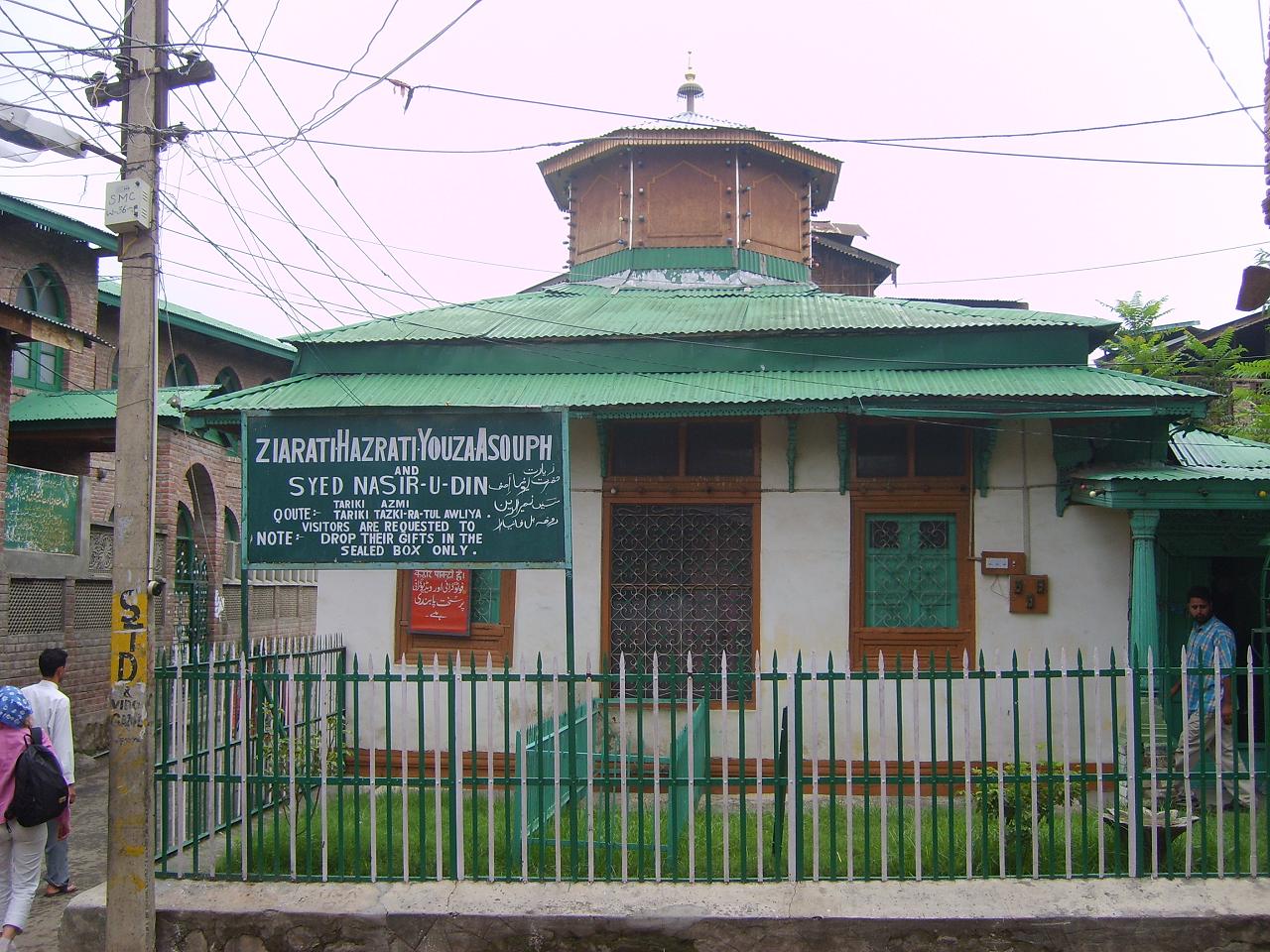
No, not another name really. While those of you from the West call him Jesus, the whole Arabic world calls him Esus, or Esau. In Kashmir he was known as Yousa-Asaf. His tomb is known as The Tomb of Yousa-Asaf who came from a very distant land and lived here. It is also indicated on the tomb that he came to live there 1900 years ago. Miguel Serrano, the author of The Serpent of Paradise, who visited the tomb, writes: ”It was evening when I first arrived at the tomb, and in the light of the sunset the faces of the men and children in the street looked almost sacred. They looked like people of ancient times; possibly they were related to one of the lost tribes of Israel that are said to have immigrated to India. Taking off my shoes, I entered and found a very old tomb surrounded by a filigree stone fence which protected it, while to one side there was the shape of a footprint cut into the stone. It is said to be the footprint of Yousa-Asaf, and according to the legend, Yousa-Asaf is Jesus.
”On the wall of the building hangs an inscription and below it a translation from the Sharda into English which reads: YOUSA-ASAF (KHANYA, SRINAGAR).”
Jesus was a totally enlightened being. This phenomenon of resurrection as far as Christian dogma is concerned seems inconceivable, but not for Yoga. Yoga believes – and there are ample proofs of it – that a person can totally die without dying. The heart stops, the pulse stops, the breathing stops – Yoga even has methods that teach this. In India we know that Jesus must have practiced some deep Yogic exercise when he was put on the cross because if the body really dies, there is no possibility of resurrection.
When those who had crucified Jesus felt that he was dead, his body was brought down from the cross and given to his followers. Then, after wrapping the body in thin muslin and an ointment, which even to this day is known as the ”ointment of Jesus,” two of his followers, Joseph and Nicodemus, removed the body to a cave, the mouth of which they blocked with a huge boulder. There is one sect, the Essenes, that has its own tradition about it. It is said that Essene followers helped Jesus to recover from his wounds. When he was seen again, because his followers could not believe that he was the same Jesus who had been crucified, the only way – and this is recorded in The Bible – was to show them his healed wounds. Those wounds were healed by the Essenes, and the healing took place during the three days when Jesus remained in the cave recovering from his ordeal. Then, when the wounds were healed, he disappeared. The huge boulder at the mouth of the cave had been rolled away and the cave was found vacant.
Jesus was not there! It is this disappearance of Jesus from the cave that has led to the common theory of his resurrection and ascent to heaven.
But after he had shown himself to his disciples he had to disappear from the country, because if he had remained there he would have been crucified again. He went to India into which, one tradition says, a tribe of the Jews had disappeared.
The famous French historian, Bernier, who visited India during the reign of Aurangzeb, wrote: ”On entering the kingdom after crossing the Pir Panjal Pass, the inhabitants of the frontier villages struck me as resembling the Jews.”
Yes, Kashmiris really do look Jewish – in their faces, in their every expression. Wherever you move in Kashmir, you feel that you are moving in a Jewish land. It is thought that Jesus came to Kashmir because it was a Jewish land in India – a tribe of Jews was living there. There are many stories in Kashmir about Jesus, but one has to go there to discover them. The crucifixion changed Jesus’ mind totally. From then on, he lived in India for seventy years continuously, in complete silence – unknown, hidden. He was not a prophet, he was not a minister, he was not a preacher. That is why not much is known about him.
Christianity lacks much. Even about Jesus it lacks much. His whole life is not known: what he practiced, how he meditated is not known. The Christian apostles who recorded what he said were ignorant people: they never knew much. One was a fisherman, another was a carpenter. All twelve apostles were ignorant. The apostles didn’t understand what Jesus was doing when he went to the hills and was silent for forty days. They only recorded that it happened and that when he came back again, he began preaching. But what was he doing there? Nothing is known – nothing. After his period of silence, he became more and more involved in something which looked more social and political than religious. It had to be so, because the people around him were absolutely non-philosophical, so whatever he said was misunderstood. When he said, ”I am the king of the Jews,” he was not talking about a kingdom of this world; he was speaking in metaphors.
Not only his enemies misunderstood him – even his followers and apostles misunderstood. They, too, began to think in terms of an earthly kingdom; they could not understand that what he was saying belonged to another world, that it was only symbolic. They also thought that Jesus was going to become king sooner or later.
That created the whole trouble. Jesus might not have been crucified in a different land, but for the Jews he was a problem. Jews are very materialistic. They were materialistic in the time of Jesus, and they still are. To them the other world is meaningless; they are only concerned with this world. Even if they talk of the other world, it is only as a prolongation of this world – not a transcendence but a continuity. They have a different way of thinking. That is why, as far as the material sciences are concerned, the Jewish contribution is so great. It
is not accidental. The person who is most responsible for molding the whole world in terms of a materialistic concept was a Jew, Karl Marx.
Karl Marx, Freud, Einstein – these three Jews are the builders of the twentieth century. Three Jews building the whole world! Why? No one exists in the world today who has not been influenced by the Jewish concept.
Jews are very down-to-earth, rooted in the earth, so when Christ began to talk like a Buddha, there was no meeting, no communion. He was continuously misunderstood.
Pilate was more understanding toward him than his own race. He continuously felt that an innocent man was being unnecessarily crucified and he tried his best not to crucify him. But then, there were political considerations. Even when they were about to crucify Jesus, at the last moment, Pilate asked him a question: ”What is truth?” Jesus remained silent. It was a Buddhist answer. Only Buddha has remained silent about truth, no one else. Something has always been said – even if it is only that nothing can be said. Only Buddha has remained silent, totally silent. And Jesus remained silent. The Jews understood this to mean that he did not know. They thought, if he knows, then of course he will say. But I have always felt that Pilate understood. He was a Roman; he might have understood. But Pilate disappeared from the scene; he put the priests in total charge and just disappeared – he did not want to be involved.
This whole thing happened because there were two languages being used. Jesus was speaking of the other world – of course, in terms of this world – and the Jews took every word literally. This would not have happened in India where there is a long tradition of parables, a long tradition of symbols. In India, the reverse misunderstanding is possible because the tradition has been going on for so long that someone speaking of this earth may be understood to be speaking of the other world. There are poets in India who talk about romance, love, and sex – of this world, totally of this world – but their followers interpret these as symbolic of the other world. Even if you talk about wine and women, they think that the wine means ecstasy and the women are devas. It happens! Jews are literal, very literal. And incredibly, they have remained the same. They are a strange race, with a different outlook from the rest of the world. That is why they have never been at home anywhere. They cannot be, because they have a different type of mind. To penetrate a Jew is always difficult. He has a certain closedness, a certain defensiveness. And the longer Jews have been homeless, the more defensive they have become. The basic thing about Jews is that they think in terms of matter – even God seems to be part of the material world. That is why it was impossible for them to understand Jesus. For example, Jews say that when someone does something wrong to you, you should do something wrong back to him – and with double the force. This is how matter behaves. React! If someone puts out one of your eyes, then put out both of his eyes.
Jesus began to say an absolutely contradictory thing: if someone slaps you on one side of the face then give him the other side also. This was absolutely Buddhist. One cannot really conceive of how a Jew could suddenly begin to talk like this. There was no tradition for it, no link with the past. Nothing happens unless there is a cause. So Jesus is inconceivable as a Jew. He suddenly happens, but he has no roots in the past of Jewish history. He cannot be connected with it because he has nothing in common with it. As far as the Jewish god is concerned, Jesus’ love, his compassion, is just nonsense.
You cannot conceive of a more jealous god, a more violent and angry god than the Jewish god. He could destroy a whole city in a single moment if someone disobeyed him. Then Jesus suddenly emerges and says, ”God is love.” It is inconceivable unless something else had penetrated the
tradition.
When Buddha talks about compassion it is not inconceivable. The whole of India has been talking about it for centuries, and Buddha is part of the tradition. But Jesus is not part of the Jewish tradition. That is why he was killed, crucified. No buddha has ever been killed in India because, however rebellious, he still belongs to the tradition; however rebellious, he conforms to the deeper ideals. One even begins to think that he is more Indian than Indian society in general because he conforms more to the basic ideals of the country.
But Jesus was a total outsider in Jerusalem, using words and symbols, a language, totally unknown to the Jews. He was bound to be crucified; it was natural. I see Jesus as living deep in meditation, deep in enlightenment, but involved with a race that was political – not religious, not philosophical. Jews have not given great philosophers to the world. They have given great scientists but not great philosophers. The very mind of the race is different; it works in a different way. Jesus was just an outsider, a stranger. He began to create trouble; he had to be made silent.
Then he escaped, and he never tried again. He lived in silence with a small group – working silently, esoterically. And I feel that there is still a hidden, esoteric tradition that continues. If one forgets Christianity and goes back to discover Jesus without the Christianity, one will be enriched. Christianity has become the barrier now. Whenever you think about Jesus, the Christian interpretation of Jesus becomes the only
interpretation. When the Dead Sea Scrolls were found twenty years ago near the Dead Sea, they caused much agitation. The Scrolls, which were originally possessed by the Essenes, are more authentic than The Bible. But Christianity could not compromise. The Dead Sea Scrolls tell a different tale, a totally different story about the Jews. Even the Koran has a different story to tell.
It seems that Mohammed also was in contact with many Jewish mystics.
This always happens: when I say something, I create two groups of people around me. One group will be exoteric. They will organize, they will do many things concerned with society, with the world that is without; they will help preserve whatsoever I am saying. The other group will be more concerned with the inner world. Sooner or later the two groups are bound to come in conflict with one another because their emphasis is different. The inner group, the esoteric mind, is concerned with something quite different from the exoteric group. And, ultimately, the outer group will win, because they can work as a group. The esoteric ones cannot work as a group; they go on working as individuals. When one individual is lost, something is lost forever. This happens with every teacher. Ultimately the outer group becomes more and more influential; it becomes an establishment. The first thing an establishment has to do is to kill its own esoteric part, because the esoteric group is always a disturbance. Because of ”heresy,” Christianity has been destroying all that is esoteric.
And now the pope is at the opposite extreme to Jesus: this is the ultimate schism between the exoteric and the esoteric. The pope is more like the priests who crucified Jesus than like Jesus himself. If Jesus comes again, he will be crucified in Rome this time – by the Vatican. The Vatican is the exoteric, organizational part, the establishment. These are intrinsic problems – they happen, and you cannot do anything about it.
Yes, Jesus was an enlightened being just like Buddha, Mahavira, Krishna.
Question
IN THE BIBLE, MANY MIRACLES ARE RECORDED. FOR EXAMPLE, THE RAISING OF LAZARUS FROM THE DEAD BY JESUS AFTER THE BODY WAS ALREADY SMELLING. IS IT
POSSIBLE FOR A DEAD MAN TO BE REVIVED?
It is possible, but it is possible in a very different way – very different. If the person is really dead, if the body is dead, then it is not possible. But it may be that the person only appears to be dead….
Question
BUT IT STATES IN THE BIBLE THAT THE BODY WAS ALREADY SMELLING.
The body may smell; the person may be in a deep coma and the body can begin to smell. There are other possibilities also, but the Jews of that time could not understand what those other possibilities were. For example, your soul may be out of the body and yet connected to it. Then the body will be in a deep coma, and it has to be preserved or it will begin to deteriorate – it is a problem now. A very strong force is needed to bring the soul which is hovering around the body back to the body. But it can be revived, and a person like Jesus can help it to revive. In India, we have many such events….
You may have heard the story about Shankara’s great debate with Mandan Mishra, the great Indian scholar of dualism.
He came to debate with him, because that was the traditional way in India. It was not a fight but a very friendly discussion, and if one could convince the other, then the other would become his disciple. With this as the condition, the debate continued. Shankara would go from one village to another all over India in order to discuss the issue with Mandan Mishra. But there was a problem: whom could they make the judge?
They were both pillars, one of dualism and the other of nondualism. Who would preside over the debate? No one was worthy of presiding. And who would be able to understand what they were saying? Who would know which one had been defeated and which one had won?
The only person possible was Mandan Mishra’s wife, and it was rare to allow a woman to preside over such a debate. But there was no other alternative, so Mandan Mishra’s wife was made the judge. Finally, Mandan Mishra was defeated. But his wife declared that even though he was defeated, he was only half defeated because she was his other half. ”So now, Shankara,” she said, ”you will have to debate with me!” It was a trick! Now Shankara was in great difficulty. It was declared that Mandan Mishra was defeated but only by half because in India we say that a
husband is only half a person, his wife is the other half, and it is the two halves which make one whole. So Mandan Mishra was only half defeated; half still remained. ”Now Mandan Mishra will preside and I will debate with you,” said the wife. And she was really a rare woman – she began to discuss sex!
Shankara was at a disadvantage. He was a celibate, so now he felt that he was going to be defeated. He knew nothing about sex; the whole phenomenon was unknown to him. It was a trick and now he was caught, so he said, ”First give me six months’ leave so that I can learn about sex. Only then can I come and discuss it with you. Otherwise I am already defeated.” And the six months’ leave was granted.
Then there was another problem – the story is beautiful – Shankara had taken a vow of celibacy for the whole of his life and so he could not use his body for any experiments in sex. Therefore he had to leave his body and enter another body, leaving his own body with his disciples to be continuously guarded and preserved, because if anything happened to it, he would not be able to enter it again. For six months a group of twelve disciples kept a constant vigil. They remained with the body continuously.
A king had just died, so when Shankara entered the king’s body, it was already dead. Then the dead body revived and Shankara lived inside the body for six months, deep in sexual experiments. The king’s wife began to feel that something was different, but what could she do? The person was different but the body was the same. After six months, Shankara returned to his own body, the discussion took place, and Bharati, Mandan Mishra’s wife, was defeated. This is one possibility: Jesus may have helped to revive Lazarus who was not really dead but only appeared to be. Christianity is unaware of many things. Lazarus may have been in a deep coma, and the body may have begun to deteriorate. And a coma can continue for years. I have seen one woman who was in a coma for nine months. If someone had not preserved the body, she would have died immediately. Everything had to be done for her. She was just lying there as if she were dead. She could not do anything for herself. Had she been forgotten for seven days she would have begun to smell, stink. So Jesus might have helped a person who was in a coma, or a person whose soul, for whatever reason, was out of his body. A dead man cannot become alive again. If he comes alive it only means that he was not really dead. As far as I am concerned, no miracle happens in the world. Something appears to be a miracle because we do not know the whole story, we do not know the whole reason for it.
Question
WHAT ABOUT THE OTHER MIRACLES REPORTED IN THE BIBLE? FOR EXAMPLE, THE ONE WHERE JESUS FED THOUSANDS OF PEOPLE WITH TWO LOAVES OF BREAD AND FIVE FISH. CAN YOU EXPLAIN IT?
Many things are possible. Nothing is a miracle, nothing. Even materialization is not a miracle: it is a science. Materialization is possible. So are many other things. Something can be brought here by an unknown route. You are not aware of the route, but something suddenly appears here. That is not materialization. A Swiss watch can be brought here from a store – spirits can help to bring it here.
You will not see the spirits, only the watch. But that is not materialization. It is just a Swiss-made watch coming here via some route that is not known. But materialization is also possible. Something coming out of nothing….
Question
HOW IS IT POSSIBLE?
When you ask how it is possible, that how is difficult to answer. You have to pass through a long, long practice to be able to do it.
Question
CAN YOU GIVE AN EXAMPLE OF THIS?
The more capable your mind becomes of concentration, the closer you come to the point where materialization can happen. If you can be in absolute concentration, materialization can happen. But with your mind the way it is, you cannot concentrate even for a single moment. If you can concentrate on something for a single moment, focusing your total mind for even one second, then you can will it to appear and it will appear.
But try it first in very easy ways. For example: you can take a glass, fill it with water, and then put some glycerin or oil on the surface of the water. Then float a very thin pin on the surface of oil or glycerin. Then concentrate on the pin. Concentrate! Without blinking, focus both your eyes on the pin for two minutes. After two minutes of concentration, begin to order the pin to go toward the right. Within seven days of practicing it, you will be able to move the pin. Once a pin can follow orders from your mind, you have achieved something that is needed for materialization. It is a long process, but now at least you can feel that mind does have power over matter. Once this power is felt, once you are totally able to concentrate, materialization becomes possible. Then only willing is needed, nothing else. If the mind is totally concentrated on making a rose appear, then a rose will appear.
Because of this, Indians have always said that the whole world is just a dream in the mind of the divine. God dreams something, and it appears. When he stops dreaming, it dissolves.
Question:
ARE YOU YOURSELF ABLE TO MAKE THINGS MATERIALISE ?
I am able to do it. And I am also able not to do it – because I feel the absurdity of it. And the second ability is better. Buddha could not be persuaded to do it, but Jesus had to do it. Again, the reason is the same: because the Jews could not believe anything unless it was something material. They could not be convinced without a miracle.
In India one can conceive of a Buddha who does not perform any miracles. But the Jews began to ask, “Can you do miracles? Only if you do miracles can we believe that what you are saying is meaningful.” It was not Jesus who wanted to do the miracles, it was the Jews who compelled him.
Without miracles, his thinking, his preaching, would have seemed meaningless to them. We cannot even conceive of Buddha’s doing miracles. It is appealing to a much lower state of mind. Why be so concerned with convincing anyone? Why be so concerned?
Sometimes a miracle would happen around Buddha, but it was not deliberately done. It would happen in a particular situation.
Still, there are layers of meaning to it. All the miracles recorded in The Bible – sometimes bread appears, sometimes disease disappears, or a dead man becomes alive again – are all very material, very ordinary things. They are concerned with the day-to-day problems of the ordinary man: bread, disease, death.
Buddha says that the whole of life is a dream. So what does it matter if someone becomes alive again? It is meaningless. It only means that a particular dream has begun to have some reality again.
There is one story recorded. Buddha was in a certain village where a child had died. The mother was so obsessed with the child that she was weeping and crying and trying to escape in order to commit suicide. So someone said, “Come to see Buddha. He can do anything. He is an enlightened man; anything is possible. Come! He is the compassionate one. If he begins to feel compassionate toward you, the child may revive.”
So she came to Buddha with the dead child in her arms and laid the child at Buddha’s feet. Imagine what would have happened to Jesus in a similar situation in a Jewish country. If the child had not been brought back to life, Jesus would have been finished completely because this would have proven that he was not the man he claimed to be.
But when the child was brought to Buddha, what did he say? He said to the mother, “I will make your child alive again, but first you will have to do one thing. Go to every house in the city and find out if there is any house where no one has ever died. If there is any house in the village where no one has ever died, then in the evening I will revive your child.”
The woman went and asked everyone. In every house, in every family, someone had died. By the time she returned in the evening she had become aware that death is a reality, death is a part of life.
Buddha asked her, “What do you say now? Is there any house, any family, any person who has not suffered due to someone’s death?”
The woman said, “I have not returned now so that my child can be revived. I have come to be initiated. Death is a reality. The child has gone, I will go, everyone will have to go. Initiate me into that life which never ends.”
This is a greater miracle! But we cannot conceive of it. If the child had been brought back to life, it would have been a miracle. But this is a greater miracle, with deeper compassion. With a particular race it is possible; otherwise, it is not possible. The woman became a sannyasin: the death of the child was not used to satisfy the lust for life, it was used for renunciation.
If Buddha’s disciples were hungry, he would not perform a miracle and provide them with bread. On the contrary, he would say, “Witness your hunger. Witness the hunger so that you can transcend it, so that you can move away from it. The hunger is not you; it is somewhere on the periphery.
Remember that. Use it.” Jesus had to supply bread and Buddha had to convince his followers to fast. To give someone bread is not a miracle really, but to make someone ready to fast is a miracle.
It depends on how we define things. I am not concerned with miracles because it is all nonsense.
This whole life that we are living is absurd, so even if you can create something in it, it is meaningless.
The only miracle that I am interested in is pushing you beyond. Even a glimpse of the beyond will be a miracle.
As I see it, if Jesus had prevented himself from doing these things, he would have served humanity better – by doing them, he attracted fools. The masses became interested in Jesus only because of his so-called miracles. He tried to help them through his miracles but it was not possible; on the contrary, he himself got into trouble.
I do not see that Christ was able to help anyone in this way.
If I were to materialize something, it would be bound to happen that fools would gather round me more and more. Soon I would be amongst fools, because only they are interested in such things.
If you go to Sai Baba (Satya Sai baba)you will see that he is doing certain things. But then only fools are attracted.
If a ring appears in my hand, what does it matter? How is it related to any spiritual phenomenon?
Even if this whole house disappears and then reappears again, what does it matter? So what? That is why I am not concerned with miracles. And those who are only attract fools.
Question
IN COMPARING JESUS TO BUDDHA, JESUS SEEMS VERY ACTIVE AND REVOLUTIONARY. WHY IS THIS?
There is a reason. But first, some explanation is needed. Yoga divides man into two parts: the sun part and the moon part. The sun is symbolic of inner positivity and the moon is symbolic of inner negativity. Sun does not mean the outer sun nor does moon mean the outer moon. These words are used for the inner universe.
There is even one breath that is known as the sun breath and another breath that is known as the moon breath. Every forty to sixty minutes, your breath changes from one nostril to the other. If you need more heat in the body, or if you suddenly grow angry, your sun breath starts functioning. Yoga says that if you use your moon breath when you are angry, then you cannot be angry at all, because
the moon breath creates a deep coolness inside. The negative is cool, silent, still. The positive is hot, vibrant with energy, active. The sun is the active part in you and the moon is the inactive part in you. When one first becomes acquainted with the sun, the light is burning hot, like a flame. If you analyze the inner life of Buddha or of Jesus with this distinction in mind, many things which are ordinarily hidden will become apparent. For example, whenever an enlightened one like Buddha is born, his early life will be very revolutionary. The moment one enters the inner dimension, the first experience is of a fiery flame. But the older Buddha grows, the more an inner coolness is felt. The more perfect the moon stage becomes, the more the revolutionary fervor is lost.
That is why Buddha’s words are not revolutionary.
Jesus did not have this opportunity. He was crucified while he was still a revolutionary and he died, as far as Christianity is concerned, at the age of thirty-three. If you compare Buddha’s sayings with those of Jesus there is a clearcut difference. Jesus’ sayings look like those of a young man – hot. Buddha’s early sayings were also like this, but he was not crucified for them; he lived to be eighty. The reason he was not crucified is that India has always known that this happens. Whenever a person moves within, whenever a buddha enters into himself, his first expression is fiery, revolutionary, rebellious. He bursts open and explodes into fire. But then that phase disappears and ultimately there is only the moon: silent, without any fire, with only light. That is why India has never killed anyone; that is why India has never behaved the way the Greeks behaved with Socrates or the Jews with Jesus.
Jesus was crucified early. Christianity still remains incomplete because Christianity is based on the early Jesus, on Jesus when he was just a flame. Buddhism is complete. It has known Buddha in all his stages. It has known Buddha’s moon in all the stages of the moon – from the first day to the full moon light.
It has been a misfortune for the West, it has proven itself to be one of the greatest misfortunes in history, that Jesus was crucified when he was just a flame, when he was only thirty-three. The flame would have turned into moonlight, but the opportunity was not given. The reason is that the Jews were not aware of the inner phenomenon.
India has known many buddhas, and it is always true that whenever someone enters the inner dimension, he has to feel the fire of the revolutionary side coming up. If one continues going inward, this dissolves, and then there is only silence, a moonlit silence. To change heat into light is the secret science of inner alchemy. To change coal into diamonds, to change baser metals into gold –
these are just symbols.
Alchemists were never really concerned with changing baser metals into higher metals, but they had to hide what they were doing. They had to create an esoteric, secret symbology, because it was very difficult in early times to talk about an inner science and not be murdered. Jesus was killed: he was an alchemist. And the Christianity that developed after Jesus went against him. The Christian Church began to kill and murder those who were practicing the alchemy of inner transformation. Christianity could not really flower into a religion; it remained a clerical thing. It could not create sannyasins, it could only create preachers – trained, dead, disciplined.
Question
IF JESUS WAS STILL IN A REBELLIOUS AND ACTIVE STAGE AT THE TIME OF THE CRUCIFIXION, DOES THAT MEAN THAT HE HAD NOT ACHIEVED THE TOTAL SPIRITUAL GROWTH AND INNER SILENCE OF BUDDHA?
At the time of the crucifixion he had just entered the moon center. But only on that very day! That has to be understood.
The Jesus of The Bible is not like Buddha, Mahavira, or Lao Tzu. You cannot conceive of Buddha’s going into a temple and beating moneylenders. But Jesus did it. There were many different activities connected with the great temple of Jerusalem. There was a great moneylending business which exploited the whole country. People would come for an annual gathering and for other gatherings during the year, and obtain money at the temple at a high rate of interest. Then it would be impossible to repay and they would lose everything.
The temple was becoming richer and richer: it was religious imperialism. The whole country was poor and suffering, but so much money would be automatically coming into the temple. Then Jesus entered one day with a whip in his hand. He overturned the moneylenders’ boards and began to beat the moneylenders. He created chaos in the temple.
You cannot conceive of Buddha doing this. Impossible! Jesus was the first communist: he was fiery, rebellious. That is why Christianity could give birth to communism. Hinduism could not give birth to it, no other religion could give birth to it; it is impossible. Only Christianity could do it, because with Jesus it has a relevance. The very language he used was totally different. He got so angry at some things that we cannot even believe it. He cursed a fig tree which was not yielding any fruit because he and his disciples were hungry. He destroyed it!
He threatened in a type of language that Buddha could not even utter. For example, he said that those who would not believe in him and the kingdom of God would be thrown into the fires of hell, the eternal fires of hell, and they would not be able to come back. Only the Christian hell is eternal. Every other hell is just a temporary punishment: you go there, you suffer, you come back. But Jesus’ hell is eternal. This looks unjust, absolutely unjust. Whatsoever the sin, eternal punishment cannot be justified. It cannot be! And what are the sins? Bertrand Russell has written a book, WHY I AM NOT A CHRISTIAN, and one of the reasons he gives is that Jesus seems absurd. Russell says, ”If I confess all the sins that I have committed, and all those sins which I have just thought about but never committed, you cannot give me more than five years’ imprisonment. But eternal hell?”
Jesus speaks the language of a revolutionary when he talks about eternal, nonending punishment – revolutionaries always look to the opposite end, to the extreme. You cannot conceive of Buddha’s saying it or Mahavira’s saying it, but Jesus says that a camel can pass through the eye of a needle sooner than a rich man can enter the kingdom of God. He cannot pass! This is the seed of communism, the basic seed. Jesus was a revolutionary. He was not only concerned with spirituality but with economics, politics – everything. Had he been only a spiritual man he would not have been crucified, but because he became a danger to the whole social structure, to the status quo, he was crucified. He was not a revolutionary like Lenin or Mao but still, Mao and Lenin and Marx are inconceivable without there having been a Jesus in history. They belong to the same path as Jesus: the early Jesus, the fiery man – rebellious, ready to destroy everything – the Jesus who was crucified. But Jesus was not simply revolutionary, he was also a spiritual man. He was, somehow, a mixture of Mahavira and Mao. The Mao was crucified and only the Mahavira remained in the end. The day Jesus was crucified was not only the day of his crucifixion, it was the day of his inner transformation also.
When Jesus remained silent after Pilate asked him, ”What is truth?” he was behaving like a Zen master. If you look at the previous life of Jesus, if you look at his whole previous life, this silence was not like Jesus at all. What happened? Why did he not speak? Why was he at a loss? He was one of the greatest orators the world has ever produced; we may even say, without hesitation, the greatest. His words were so penetrating. He was a man of words, not a man of silence. Why did he suddenly remain silent?
He was moving toward the cross. Pilate asked him, ”What is truth?” Jesus had spent his whole life talking about truth; he was defining only that, that is why Pilate asked him. But he remained silent. What happened in Jesus’ inner world has never been reported because it is difficult to report. Christianity has allowed it to remain submerged because what happened in the inner world of Jesus can only be interpreted in India, nowhere else. Only India knows about the inner changes, the inner transformation that happens. What happened was this: Jesus is suddenly on the verge of crucifixion. He is about to be crucified and now his whole revolution is meaningless. Everything that he has been saying is futile, everything that he has been living for is coming to an end. Everything is finished. And because death is so near, he must now move within. No time can be lost, not a single moment can be lost. He must come to the end of his journey now, and before he is crucified he must complete the inner journey. All along he had been on an inner journey. But because he was also entangled with outer problems he could not move to that cool point, the moon point; he remained fiery, hot. But it may be that he did this consciously. Jesus was a disciple of John the Baptist who was a great revolutionary and spiritual leader. John the Baptist had waited for Jesus for many years. Then, on the day he initiated Jesus in the River Jordan, he said to Jesus, ”Now take over my work and I will disappear. It is enough.” And from that day on, he was rarely seen again; he disappeared. In the words of the inner language, he disappeared from the sun point and moved to the moon point; he became silent. He had done his work and had now given the work to someone who would complete it.
On the day of the crucifixion Jesus must have become aware that now his work was finished: ”There is no longer any possibility of doing anything more now. I must move within. The opportunity must not be lost.” That is why, when Pilate asked him what truth is, he remained silent. Because of this, the miracle happened which has remained an enigma for Christianity. Because of this. As he was moving to his cooler side, to the moon center, he was crucified. When someone comes to the moon center for the first time, his breathing stops because breathing, too, is an activity of the sun point. Now everything becomes silent; everything is as if dead. They thought he was dead, but he was not. He had simply come to the moon center where breathing stops: no outgoing breath, no ingoing breath – the gap. When one remains in the gap, there is such a deep balance that it is a virtual death. But it is not death. The crucifiers, the murderers of Jesus, thought that he was dead so they allowed his disciples to bring the body down. But he was not dead, and when the cave was opened after three days he was not there. The ”dead” body had disappeared. After three days, Jesus was seen again by four or five people. But no one would believe them when they went to the villages to say that Jesus was resurrected. No one would believe it. When he escaped from Jerusalem, Jesus went to Kashmir, where he remained. But then his life was not the life of Jesus but the life of Christ. Jesus was the sun point and Christ the moon point. From then on, he remained totally silent. That is why there is no record of him. He would not talk, he would not deliver any message, he would not preach. He remained in Kashmir, not as a revolutionary but as a master, living in his own silence. A few people traveled to be with him. Those who became aware of his presence in Kashmir, without having had any outward information about it, would travel to him. And really, there were not so few – maybe only a few in comparison to the world, but there were many.
Christianity is incomplete because it knows only the early, revolutionary Jesus. And because of that, Christianity could give birth to communism. But Jesus himself died as a fully enlightened man – a full moon.
Shivarathri means ‘the night of Shiva’ and is observed in honour of Lord Shiva (The meditative aspect of the Universe). According to the legend from Shivapurana, when Shiva was asked by Parvathi what pleases him most, He is supposed to have replied thus: ‘The 14th night of the new moon, in the dark fortnight during the month of phalgun, is my most favorite day. It is known as Shivarathri’.
Shiva is the meditative aspect of the entire Universe. Shiva pervades the entire Universe. He is in every atom of the Universe. He has no form but is in every form, so full of compassion. Ling means symbol (chinha in Hindi) that is how it’s come to be used as in Striling, Pulling, (female and male gender) Chinha means that through which you can recognize the whole consciousness represented in the Ling. In Tamil there is a saying“Anbe Shivan, Shivan Anbe” means Shiva is love and love is Shiva, the soul of the creation called Isha or Shiva.
The devotees, in order to bring balance in the rajas (The primordial guna which brings forth activity) and Tamas(The primordial guna which brings forth inertia), and to uplift sattva (The primordial guna which gets the tasks accomplished), observe fast on this day. They keep awake at night and Shiva Lingam is worshipped throughout the night by washing it every three hours with milk, curd, honey, rose water, etc. whilst the chanting of Om Namah Shivaya continues. Bael leaves considered sacred to Lord Shiva are offered. Hymns in praise of Lord Shiva are sung. The traditional ritual is done to bring auspicious energy on the Earth and enriches the space within. However, the devotion plays the utmost role. The Om Namah Chanting is done to harmonize the five elements in the environment.
Three Forces of Creation
This universe has been in existence continuously for billions of years.
What are the basic forces of Nature that keep it going this way?
In the building blocks of creation, there are three quarks. These 3 quarks create stability in the creation process. The three quarks are expressed as three colours for want of any other name. The colours of the quarks are not discernable.
Dr.Archana Sharma, Senior Physicist, CERN, says, “At the time of Creation, once the God Particle makes its presence felt, under the influence of its field, 3 quarks group together to make up a stable proton and many other particles which form the constituents of matter. These are formed within nano seconds after the Big Bang. When 2 come together, they do not form a stable particle again. 3 are needed for a stable proton to take shape.”
Indian thought has a similar concept expressed as Trigunatmikaprakrithi, where the soul, the essence of the universe is made of three subtle characteristics. It is these that keep the universe ceaselessly flowing from inception to infinity.
Tri means “three”, Guna means “characteristic attributes”, Atmika is that which comes from Atma, the soul, “the subtle basis of everything” and Prakrithi means Nature “the very nature of this universe”.
Trigunatmikaprakrithi is that which naturally possess three attributes of which this whole Creation is sustained by.
While this insight is from tradition Indian knowledge, modern research also speaks the need of the three forces that keep the universe in a continuously flowing state.