
Author Archives: Vilok

Reason why British left India in 1947

British - India
Writing in his much-acclaimed book Indian Struggle, Subhas Chandra Bose stated, “Mahatma Gandhi has rendered and will continue to render phenomenal service to his country.” “But”, he added, “India’s salvation will not be achieved under his leadership.”

Nearly 70 years after power was transferred to Indian hands, sufficient information has come on record to give a new thrust to the old question: “Who brought India freedom — Gandhi or Bose?”

The people who were best positioned to answer the question were those who had an inside knowledge of the situation as it prevailed in India from 1942 to 1947. In 1942, Gandhi launched the Quit India movement. The view from the Bose’s side was that it was his suggestion in 1939 to serve a 6-month’s ultimatum on the British Government, which was accepted by Gandhi in totality in his Quit India resolution of August 1942. Prior to this, Gandhi was, as Bose himself stated repeatedly, most reluctant to launch a movement. This is what he wrote in Indian Struggle.

“On 6 September(1939), Mahatma Gandhi, after meeting the Viceroy, Lord Linlithgow, issued a press statement saying that in spite of the differences between India and Britain on the question of Indian independence, India should cooperate with Britain in her hour of danger. This statement came as a bombshell to the Indian people, who since 1927 had been taught by the Congress leaders to regard the next war as a unique opportunity for winning freedom.”

Be that as it may, the Quit India movement was launched in good earnest. Bose praised Gandhi’s stirring speech as he launched it. But, unfortunately, the movement was “crushed within 3 weeks”. Thus spake Khushwant Singh, someone who was not a fan of Subhas Bose. Anyhow, having lived through those times, Singh further explained: “The British were not evicted from India; they found it increasingly difficult to rule it and decided to call it a day.”

So what happened between 1942 and 1947 that made the British take the call? Conventional wisdom can be explained by way of 1954 Bollywood hit “दे दी हमें आज़ादी बिना खडग बिना ढाल/साबरमती के संत तू ने कर दिया कमाल”, which extols Gandhi for having singlehandedly delivered freedom to India solely through the non-violent means. Celebrated historians and researchers with all their experience and exposure (which doesn’t come easily to those who go against the current) can put it better

There is a ground rule in journalism — and also in intelligence — that if 3 informed reliable sources independent of each other make similar statements, the sum of their statements has to as close to truth as one gets it.

So let’s try and connect some dots and see what story they tell.

As late as 1946, Gandhi stated, “We shall be able to win freedom only through the principles the Congress has adopted for the past 30 years.” Gandhi’s own three pet principles were “truth, ahimsa and brahmacharya”. The first 2 are well-espoused by Gandhians, who rather not speak about the third for it is a blot on the Gandhian legacy.

No one knew India’s internal situation better than the Director, Intelligence Bureau. One who thinks it’s the editor of some newspaper is superficial. Here’s what Sir Norman Smith, DIB, noted in a secret report of November 1945 that was declassified in the 1970s: “The situation in respect of the Indian National Army is one which warrants disquiet. There has seldom been a matter which has attracted so much Indian public interest and, it is safe to say, sympathy… the threat to the security of the Indian Army is one which it would be unwise to ignore.”

An agreement of sort came from Lt General SK Sinha, former Governor of Jammu & Kashmir and Assam, who was one of the only 3 Indian officers posted in the Directorate of Military Operations in New Delhi in 1946. “There was considerable sympathy for the INA within the Army… It is true that fears of another 1857 had begun to haunt the British in 1946.” Sinha wrote this in 1976.

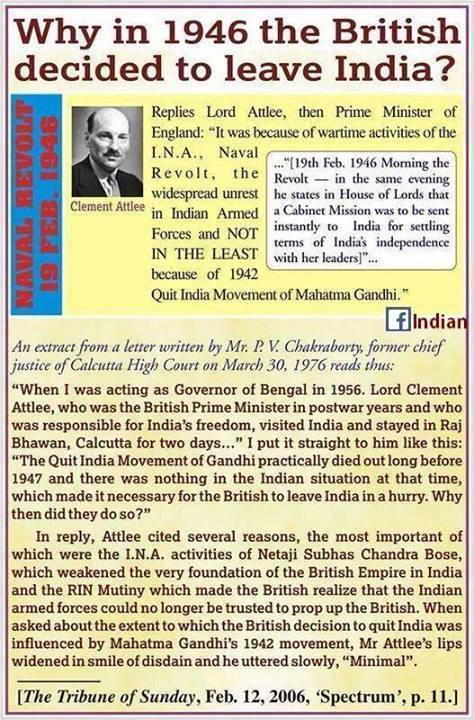
Agreeing with this contention were a number of British MPs who met British Prime Minister Clement Attlee in February 1946. “There are two alternative ways of meeting this common desire (a) that we should arrange to get out, (b) that we should wait to be driven out. In regard to (b), the loyalty of the Indian Army is open to question; the INA have become national heroes….” This minute too was declassified in the 1970s.

A most valuable light on the role of the INA was thrown by Bhimrao Ambedkar in February 1956, a few months before he passed away, in a tell-all interview to the BBC. “I don’t know how Mr Attlee suddenly agreed to give India independence… It seems to me from my own analysis that two things led the Labour party to take this decision: 1. The national army that was raised by Subhas Chandra Bose. The British had been ruling the country in the firm belief that whatever may happen in the country or whatever the politicians do, they will never be able to change the loyalty of soldiers. That was one prop on which they were carrying on the administration. And that was completely dashed to pieces.”

The clincher of an argument came from Earl Attlee himself as he visited India in October 1956. Some 2 decades later, PB Chakravarty, Chief Justice of Calcutta High Court and acting Governor of West Bengal in 1956, recalled his talks with the former British PM in the following words: “Toward the end of our discussion I asked Attlee what was the extent of Gandhi’s influence upon the British decision to quit India. Hearing this question, Attlee’s lips became twisted in a sarcastic smile as he slowly chewed out the word, ‘m-i-n-i-m-a-l!”

British historian Michael Edwardes fairly summed this up in his 1964 book, The Last Years of British India. “It slowly dawned upon the Government of India that the backbone of the British rule, the Indian Army, might now no longer be trustworthy. The ghost of Subhas Bose, like Hamlet’s father, walked the battlements of the Red Fort (where the INA soldiers were being tried), and his suddenly amplified figure overawed the conference that was to lead to Independence.”

It is a wide known fact that Bose met Hitler during WW-2 & had the german support against the Brits. He also met many Indian POWs in German ccamps & motivated them to fight for independance against the Imperialist British.

The crucial point to note is that thanks to Subhas Chandra Bose’s activities, the Indian Armed Forces began to see themselves as defenders of India rather than of the British Empire. This, more than anything else, was what led to India’s freedom. This is also the reason why the British Empire disappeared from the face of the earth within an astonishingly short space of twenty years. Indian soldiers, who were the main prop of the Empire, were no longer willing to fight for the British. What influenced the British decision was mutiny of the Indian Navy following the INA trials in 1946. While the British wanted to try Subhas Chandra Bose’s INA as traitors, Indian soldiers saw them as nationalists and patriots. This scared the British. They decided to get out in a hurry.

(Attlee repeated his argument on at least two other occasions, including once in the House of Commons. During a debate in the House of Commons, he told Churchill that he would agree to the latter’s suggestion of holding on to India if he could guarantee the loyalty of the Indian armed forces. Churchill had no reply. The Labour Prime Minister was as much an imperialist as Churchill, but more pragmatic, prepared to see the writing on the wall.)

This will come as a shock to most Indians brought up to believe that the Congress movement driven by the ‘spiritual force’ of Mahatma Gandhi forced the British to leave India. But both evidence and the logic of history are against this beautiful but childish fantasy. It was the fear of mutiny by the Indian armed forces – and not any ‘spiritual force’ – that forced the issue of freedom. The British saw that the sooner they left the better for themselves, for, at the end of the war, India had some three million men under arms. One would have to be extraordinarily dense – which the British were not – to fail to see the writing on the wall.

So, as the great historian R.C. Majumdar wrote, Subhas Bose with his INA campaigns probably contributed more to Indian independence than Gandhi, Nehru and their movements. The result of Subhas Chandra Bose’s activities was the rise of the nationalist spirit in the Indian Armed Forces. This is the reason why Nehru, after he became Prime Minister, did everything possible to turn Bose into a non-person. He wanted no rivals.

As Jawaharlal Nehru delivered his famous “Tryst with destiny” speech, not a word in it was devoted to Bose or his INA, but without whom the transfer of power wouldn’t have taken place in 1947.

Also check the video
https://www.youtube.com/watch?v=c579ZHgc9IM&feature=player_embedded

Life is purposeless !!!

“Life is purposeless. Don’t be shocked.
“The whole idea of purpose is wrong – it comes out of greed.
Life is a sheer joy, a playfulness, a fun, a laughter, to no purpose at all. Life is its own end, it has no other end.
The moment you understand it you have understood what meditation is all about. It is living your life joyously, playfully, totally, and with no purpose at the end, with no purpose in view, no purpose there at all.
Just like small children playing on the sea beach, collecting seashells and colored stones – for what purpose?
“There is no purpose at all.”

~ Osho, Zen: Zest Zip Zap and Zing, Talk #11

The history of Christmas

The History of Christmas

I. When was Jesus born?

A. Popular myth puts his birth on December 25th in the year 1 C.E.

B. The New Testament gives no date or year for Jesus’ birth. The earliest gospel – St. Mark’s, written about 65 CE – begins with the baptism of an adult Jesus. This suggests that the earliest Christians lacked interest in or knowledge of Jesus’ birthdate.

C. The year of Jesus birth was determined by Dionysius Exiguus, a Scythian monk, “abbot of a Roman monastery. His calculation went as follows:

a. In the Roman, pre-Christian era, years were counted from ab urbe condita (“the founding of the City” [Rome]). Thus 1 AUC signifies the year Rome was founded, 5 AUC signifies the 5th year of Rome’s reign, etc.

b. Dionysius received a tradition that the Roman emperor Augustus reigned 43 years, and was followed by the emperor Tiberius.

c. Luke 3:1,23 indicates that when Jesus turned 30 years old, it was the 15th year of Tiberius reign.

d. If Jesus was 30 years old in Tiberius’ reign, then he lived 15 years under Augustus (placing Jesus birth in Augustus’ 28th year of reign).

e. Augustus took power in 727 AUC. Therefore, Dionysius put Jesus birth in 754 AUC.

f. However, Luke 1:5 places Jesus’ birth in the days of Herod, and Herod died in 750 AUC – four years before the year in which Dionysius places Jesus birth.

D. Joseph A. Fitzmyer – Professor Emeritus of Biblical Studies at the Catholic University of America, member of the Pontifical Biblical Commission, and former president of the Catholic Biblical Association – writing in the Catholic Church’s official commentary on the New Testament[1], writes about the date of Jesus’ birth, “Though the year [of Jesus birth is not reckoned with certainty, the birth did not occur in AD 1. The Christian era, supposed to have its starting point in the year of Jesus birth, is based on a miscalculation introduced ca. 533 by Dionysius Exiguus.”

E. The DePascha Computus, an anonymous document believed to have been written in North Africa around 243 CE, placed Jesus birth on March 28. Clement, a bishop of Alexandria (d. ca. 215 CE), thought Jesus was born on November 18. Based on historical records, Fitzmyer guesses that Jesus birth occurred on September 11, 3 BCE.

F. Luke 2:8 explains that when Christ was born, “there were in the same country shepherds abiding in the field, keeping watch over their flock by night.” Note that they were “abiding” in the field. This never happened in December. Both Ezra 10:9-13 and the Song of Solomon 2:11 show that winter was the rainy season and shepherds could not stay on cold, open fields at night.

II. How Did Christmas Come to Be Celebrated on December 25?

A. Roman pagans first introduced the holiday of Saturnalia, a week long period of lawlessness celebrated between December 17-25. During this period, Roman courts were closed, and Roman law dictated that no one could be punished for damaging property or injuring people during the weeklong celebration. The festival began when Roman authorities chose “an enemy of the Roman people” to represent the “Lord of Misrule.” Each Roman community selected a victim whom they forced to indulge in food and other physical pleasures throughout the week. At the festival’s conclusion, December 25th, Roman authorities believed they were destroying the forces of darkness by brutally murdering this innocent man or woman.

B. The ancient Greek writer poet and historian Lucian (in his dialogue entitled Saturnalia) describes the festival’s observance in his time. In addition to human sacrifice, he mentions these customs: widespread intoxication; going from house to house while singing naked; rape and other sexual license; and consuming human-shaped biscuits (still produced in some English and most German bakeries during the Christmas season).

C. In the 4th century CE, Christianity imported the Saturnalia festival hoping to take the pagan masses in with it. Christian leaders succeeded in converting to Christianity large numbers of pagans by promising them that they could continue to celebrate the Saturnalia as Christians.[2]

D. The problem was that there was nothing intrinsically Christian about Saturnalia. To remedy this, these Christian leaders named Saturnalia’s concluding day, December 25th, to be Jesus’ birthday.

E. Christians had little success, however, refining the practices of Saturnalia. As Stephen Nissenbaum, professor history at the University of Massachussetts, Amherst, writes, “In return for ensuring massive observance of the anniversary of the Savior’s birth by assigning it to this resonant date, the Church for its part tacitly agreed to allow the holiday to be celebrated more or less the way it had always been.” The earliest Christmas holidays were celebrated by drinking, sexual indulgence, singing naked in the streets (a precursor of modern caroling), etc.

F. The Reverend Increase Mather of Boston observed in 1687 that “the early Christians who first observed the Nativity on December 25 did not do so thinking that Christ was born in that Month, but because the Heathens’ Saturnalia was at that time kept in Rome, and they were willing to have those Pagan Holidays metamorphosed into Christian ones.”[3] Because of its known pagan origin, Christmas was banned by the Puritans and its observance was illegal in Massachusetts between 1659 and 1681.[4] However, Christmas was and still is celebrated by most Christians.

G. Some of the most depraved customs of the Saturnalia carnival were intentionally revived by the Catholic Church in 1466 when Pope Paul II, for the amusement of his Roman citizens, forced Jews to race naked through the streets of the city. An eyewitness account reports, “Before they were to run, the Jews were richly fed, so as to make the race more difficult for them and at the same time more amusing for spectators. They ran… amid Rome’s taunting shrieks and peals of laughter, while the Holy Father stood upon a richly ornamented balcony and laughed heartily.”[5]

H. As part of the Saturnalia carnival throughout the 18th and 19th centuries CE, rabbis of the ghetto in Rome were forced to wear clownish outfits and march through the city streets to the jeers of the crowd, pelted by a variety of missiles. When the Jewish community of Rome sent a petition in1836 to Pope Gregory XVI begging him to stop the annual Saturnalia abuse of the Jewish community, he responded, “It is not opportune to make any innovation.”[6] On December 25, 1881, Christian leaders whipped the Polish masses into Antisemitic frenzies that led to riots across the country. In Warsaw 12 Jews were brutally murdered, huge numbers maimed, and many Jewish women were raped. Two million rubles worth of property was destroyed.

III. The Origins of Christmas Customs

A. The Origin of Christmas Tree
Just as early Christians recruited Roman pagans by associating Christmas with the Saturnalia, so too worshippers of the Asheira cult and its offshoots were recruited by the Church sanctioning “Christmas Trees”.[7] Pagans had long worshipped trees in the forest, or brought them into their homes and decorated them, and this observance was adopted and painted with a Christian veneer by the Church.

B. The Origin of Mistletoe
Norse mythology recounts how the god Balder was killed using a mistletoe arrow by his rival god Hoder while fighting for the female Nanna. Druid rituals use mistletoe to poison their human sacrificial victim.[8] The Christian custom of “kissing under the mistletoe” is a later synthesis of the sexual license of Saturnalia with the Druidic sacrificial cult.[9]

C. The Origin of Christmas Presents
In pre-Christian Rome, the emperors compelled their most despised citizens to bring offerings and gifts during the Saturnalia (in December) and Kalends (in January). Later, this ritual expanded to include gift-giving among the general populace. The Catholic Church gave this custom a Christian flavor by re-rooting it in the supposed gift-giving of Saint Nicholas (see below).[10]

D. The Origin of Santa Claus

a. Nicholas was born in Parara, Turkey in 270 CE and later became Bishop of Myra. He died in 345 CE on December 6th. He was only named a saint in the 19th century.

b. Nicholas was among the most senior bishops who convened the Council of Nicaea in 325 CE and created the New Testament. The text they produced portrayed Jews as “the children of the devil”[11] who sentenced Jesus to death.

c. In 1087, a group of sailors who idolized Nicholas moved his bones from Turkey to a sanctuary in Bari, Italy. There Nicholas supplanted a female boon-giving deity called The Grandmother, or Pasqua Epiphania, who used to fill the children’s stockings with her gifts. The Grandmother was ousted from her shrine at Bari, which became the center of the Nicholas cult. Members of this group gave each other gifts during a pageant they conducted annually on the anniversary of Nicholas’ death, December 6.

d. The Nicholas cult spread north until it was adopted by German and Celtic pagans. These groups worshipped a pantheon led by Woden –their chief god and the father of Thor, Balder, and Tiw. Woden had a long, white beard and rode a horse through the heavens one evening each Autumn. When Nicholas merged with Woden, he shed his Mediterranean appearance, grew a beard, mounted a flying horse, rescheduled his flight for December, and donned heavy winter clothing.

e. In a bid for pagan adherents in Northern Europe, the Catholic Church adopted the Nicholas cult and taught that he did (and they should) distribute gifts on December 25th instead of December 6th.

f. In 1809, the novelist Washington Irving (most famous his The Legend of Sleepy Hollow and Rip Van Winkle) wrote a satire of Dutch culture entitled Knickerbocker History. The satire refers several times to the white bearded, flying-horse riding Saint Nicholas using his Dutch name, Santa Claus.

g. Dr. Clement Moore, a professor at Union Seminary, read Knickerbocker History, and in 1822 he published a poem based on the character Santa Claus: “Twas the night before Christmas, when all through the house, not a creature was stirring, not even a mouse. The stockings were hung by the chimney with care, in the hope that Saint Nicholas soon would be there…” Moore innovated by portraying a Santa with eight reindeer who descended through chimneys.

h. The Bavarian illustrator Thomas Nast almost completed the modern picture of Santa Claus. From 1862 through 1886, based on Moore’s poem, Nast drew more than 2,200 cartoon images of Santa for Harper’s Weekly. Before Nast, Saint Nicholas had been pictured as everything from a stern looking bishop to a gnome-like figure in a frock. Nast also gave Santa a home at the North Pole, his workshop filled with elves, and his list of the good and bad children of the world. All Santa was missing was his red outfit.

i. In 1931, the Coca Cola Corporation contracted the Swedish commercial artist Haddon Sundblom to create a coke-drinking Santa. Sundblom modeled his Santa on his friend Lou Prentice, chosen for his cheerful, chubby face. The corporation insisted that Santa’s fur-trimmed suit be bright, Coca Cola red. And Santa was born – a blend of Christian crusader, pagan god, and commercial idol.

IV. The Christmas Challenge

· Christmas has always been a holiday celebrated carelessly. For millennia, pagans, Christians, and even Jews have been swept away in the season’s festivities, and very few people ever pause to consider the celebration’s intrinsic meaning, history, or origins.

· Christmas celebrates the birth of the Christian god who came to rescue mankind from the “curse of the Torah.” It is a 24-hour declaration that Judaism is no longer valid.

· Christmas is a lie. There is no Christian church with a tradition that Jesus was really born on December 25th.

· December 25 is a day on which Jews have been shamed, tortured, and murdered.

· Many of the most popular Christmas customs – including Christmas trees, mistletoe, Christmas presents, and Santa Claus – are modern incarnations of the most depraved pagan rituals ever practiced on earth.

Many who are excitedly preparing for their Christmas celebrations would prefer not knowing about the holiday’s real significance. If they do know the history, they often object that their celebration has nothing to do with the holiday’s monstrous history and meaning. “We are just having fun.”

LAWRENCE KELEMEN

Alternate sources – The Speaking tree

Shiva the Eternal Mystique

Q: Who is Shiva?

Sri Sri: I would ask the question what is not Shiva. Just now you heard the invocation. Is Shiva a form, is he someone sitting somewhere? Shiva is the one from where everything has come and in which everything is sustained, and into which everything dissolves. There is no way you can step out of Shiva. Shiva is Vishwa Rupa, the form of Shiva is the whole Universe, yet he is formless. Through Omkara you can know him. Go deep into the primordial sound of the Universe. How can you understand? Through the knowledge you hear in deep meditation – the shrutis. Only in the depth of wisdom, you can understand what Shiva is.

Tamo yoga gamaya- through penance and yoga you can experience. There is a beautiful story, once Brahma and Vishnu wanted to understand Shiva completely. Vishnu went down for thousands of years to find Shiva’s feet and Brahma went up to find Shiva’s head. Means there is no beginning and no end to Shiva.

Linga is simply a symbol. Shiva tattva is the most beautiful tattva and it is most difficult to talk about also. It can only be felt, beyond understanding. Still we make a little effort to understand it. When words go that close and returns, that is Shiva. Even mind cannot understand it. That is a big challenge to even talk about this most beautiful tattva.

Q: How can we experience Shiva every moment?

Sri Sri: The experiencer himself is Shiva. You simply have to be present in the moment and Shiva tattva is already there. We have waking, dreaming, and sleeping states of consciousness. The fourth state of consciousness is Shiva. When you are meditating, you are neither waking nor sleeping. That glimpse of the fourth state is Shiva tattva. It is so auspicious, there is no two, peace, that is what is your Self, that is worth knowing: that is what the Vedanta says. Who you think you are is not just a name, is not just a form, that scintillating consciousness in you is Shiva.

Q: Mrityunjaya mantra is supposed to give victory over death.

Sri Sri: Mrityunjaya mantra is one of the most reverent mantra in the Vedic tradition. Markandaya Rishi chanted this mantra. Mrtiyu means death. Jaya means victory over death. Victory for the soul or the body? Every moment the body is changing. Our body is a township. Like in a town new children are being born. Mrityunjaya means victory over the mind, the mind realizes that there is something in me that is not changing. Then there is no fear. Fear is one of the signs of death. You win over the fear. You win over the small mindedness of identification with the perishable and move to the imperishable. We are combination of both: our spirit is imperishable and the body is perishable.

There is a prayer : Let Shiva make me strong. Let him make me strong. Let him give me relief. Desire to be free from bondage takes you out from bondage.

Q: Why is Shiva depicted as Nataraja?

Sri Sri: The cosmos is not a journey to somewhere. Usually people ask what is the purpose of life. Creation is simple a display and play of consciousness. Like the dancer and dance cannot be separated, similarly the Creation and the Creator are not two separate things. This truth was depicted in the form of Nataraja. There is wind in one hand, deer depicts air, fire element, space element is depicted with a little conical drum (damru). The dance of consciousness is the whole Universe. This universe is celebrating everyday. This truth is brought out. One who does not know this, suffers. One who knows that this whole creation is a dance, is an expression of joy, that truth is Shiva tattva.

Q: Lord Shiva wears Vibhuti on his body. There is a song which expounds the importance of Vibhuti. Could you please explain the song?

Sri Sri: Shiva’s temple is the consciousness. Shiva is not in the stones, in temples, he is in the consciousness of the human beings. Our body all becomes ashes, ash is the last, the ultimate. Vibhuti does not mean the ashes one puts on the head. The devotee says you are the mantra and you are above all Gods, you are all wealth, you are everything. Vibhuti also means blessings that get bestowed, the great things, the ultimate things. The devotee always thinks bigger, he wears the ultimate. Shiva means in the consciousness of the Universe. That which encompasses the whole Universe, that something in which every life is. Reminding everyone of the unfathomable, incomprehensible, the mystical Shiva tattva.
Atma tvam – The stage comes when the realization comes – my intellect is Parvati, the Prana is all paraphernalia Gods or accompaniments. There are 5 pranas and 5 up-pranas. The Puranas give something for people at every level. You cannot give Quantum Physics knowledge to a child. Different levels of understanding exist in the society and the Puranas cater to every level.

A popular TV serial has come on Shiva. In TV, they dramatize a little more. It does not have a scriptural basis. Parvati keeps crying and Shiva has to please her. I told them and sent them a letter that you have not shown the mental state of Parvati properly. From Kashmir’s Shaivism to the South, there is very beautiful depiction of the Shiva Tattva.

Jesus & Buddha

Jesus says: Ask, and it shall be given. Buddha says: Ask not, and it shall be given. Jesus says: Seek, and ye shall find. Buddha says: Seek not, and ye shall find. Jesus says: Knock, and the doors shall be opened unto you. Buddha says: There is no need to knock; the doors are already open.
Why this difference between two enlightened persons? Both are awakened. The difference is because of the audience. Jesus is speaking to very ordinary people; Buddha is speaking to his commune – that is the difference. He can speak the highest truth without any compromise. Jesus cannot. Jesus has to compromise with the listeners.
Jesus lived without a commune. Yes, a few disciples he had, twelve disciples – and those twelve disciples are also not of much worth. Buddha had thousands of disciples and of tremendous value – because many of them became enlightened while Buddha was alive. In his commune there were at least one thousand enlightened people, of the same status as he himself was. He could talk in any possible way and it would not be misunderstood; there was no worry on his part about being misunderstood. Jesus had to be constantly on guard, and even then he was misunderstood and crucified.

~ Osho – Dhammapada Volume 8